

Temple of Dendera (Temple of Hathor)

Introduction
The Temple of Dendera, originally called Iunet or Tentyra. Is situated close to the village of Dendera in the Qena Governorate. It rests on the eastern bank of the Nile River. Northwest of Qena city, and approximately 60 to 70 kilometers north of Luxor. The archaeological site lies about 2.5 kilometers southeast of the modern village of Dendera. Enclosed by a mudbrick and stone wall, the temple complex stands as one of the most well-preserved sites in Egypt.

Date Of Construction And Patrons Chronology And Major Building Phases
Ancient Origins:
The site has served as a place of worship since ancient times. With archaeological evidence dating back to the Old and Middle Kingdoms. Remnants of earlier temples, including structures potentially as old as the 22nd Dynasty. Underscore the location’s longstanding significance as a religious center spanning millennia.

Current Structure:
The temple visible today owes its origins to the Ptolemaic period. The primary construction of this monument, dedicated to Hathor, commenced toward the end of the 1st century BC. Historical sources indicate that work began around 54 BC during the reign of Ptolemy XII Auletes. Subsequent Ptolemaic rulers continued construction and enhancements, while later Roman contributions brought further refinements, including major projects such as the hypostyle hall.
Roman Contributions:
The hypostyle hall stands as a notable achievement from the Roman period, adorned with elaborate reliefs contributed by various emperors, including Tiberius. These artistic and architectural efforts extended well into the 1st century AD, showcasing a harmonious blend of Ptolemaic and Roman influences.
In summary, the site has been revered since antiquity. The monumental stone temple observed today represents a synthesis of Ptolemaic and Roman craftsmanship, initiated under Ptolemy XII Auletes (~54 BC) and brought to completion through successive efforts during the Roman era.

Who Spearheaded the Construction of the Temple?
The masterminds behind the construction of this monumental temple span across two great civilizations: the Ptolemies of Egypt and the Romans. Each left a distinct mark on its legacy, contributing to its grandeur at different times in history.
The Visionary Patrons:
The Ptolemies of Egypt When it comes to the primary architects of this iconic structure, credit is due to the Ptolemies, the ruling dynasty of Egypt during the Hellenistic period. Ptolemy XII Auletes laid the foundation for this ambitious undertaking, breathing life into the project with his leadership. Successive Ptolemaic rulers picked up where he left off, carrying the torch forward with unwavering dedication. Remarkably, even Queen Cleopatra VII—the last of the Ptolemies—contributed to enhancing this masterpiece by overseeing some of its intricate decorations and inscriptions during the twilight of her dynasty.

The Roman Legacy
Fast-forward to the Roman era; this awe-inspiring edifice witnessed yet another phase of transformation. After conquering Egypt, the Romans ensured that these sacred structures continued to thrive. Notable figures like Emperor Tiberius, along with other prominent generals and imperial dignitaries, infused their influence into the temple during the 1st century AD. They revamped certain areas, most famously adding exquisite decorations to the great hall, thereby bridging two worlds Ptolemaic tradition and Roman innovation.
Through their combined efforts, these two powers shaped a temple that stands as a testament to a convergence of artistry and vision, reflecting both Egyptian and Greco-Roman cultures. Their legacy endures in every stone and carving, captivating generations even today.

There Is Any Of “Burials” Or Tombs Been Found Inside The Temple?
Are burials or tombs hidden inside ancient Egyptian temples? This is a question that sparks curiosity and sometimes confusion. Especially among those who are just beginning to explore the incredible world of Egyptian history. Let’s break it down and clear up the misconceptions, focusing on what temples are designed for, and why this distinction between temples and tombs matters.
First and foremost, it’s important to understand that Egyptian temples are not tombs. Their purpose within the ancient world was entirely different. Temples were sacred spaces dedicated to rituals, housing statues of deities, and serving as centers for offerings and worship. In contrast, tombs served as eternal resting places for kings, nobles. And others, primarily located on the west bank of the Nile in areas like the Valley of the Kings. The Valley of the Queens, and other funerary necropolises. That’s why you won’t find royal tombs hidden within cultic structures such as the grand Karnak Temple or the beautiful Dendera Temple.

So, if burials aren’t found in these temples, what lies within? Let’s journey inside Dendera Temple to understand what discoveries have fueled some of these mistaken notions.
One of the most intriguing features of the Temple of Dendera is its crypts. A network of underground chambers hidden beneath the temple floor. There are around twelve such crypts, adorned with intricate carvings, ritual texts, and inscriptions that narrate religious stories and practices. These crypts were far from burial sites. Instead, they functioned as secure storerooms for sacred objects, divine statues. And treasures, many of which were too precious or holy to be on public display. Some inscriptions even offer detailed information about the locations or inventories of these items.

Interestingly
certain writings in these crypts bear the names and accounts of donations from the late Ptolemaic period. Up until the reign of Ptolemy XII. These inscriptions may have contributed to the mistaken belief that Dendera was a temple filled with tombs. But understanding their true purpose reveals how meticulous and organized. Ancient Egyptians were when it came to safeguarding their sacred belongings.
Now, about burials connected to Dendera they can be found, but not within the temple itself. The inhabitants’ and notables’ necropolis lies adjacent to the temple complex. These burial grounds date back to much earlier times, as far back as the Predynastic era. This separation between religious structures like temples and burial sites highlights the distinct roles each space played in Egyptian society.

The most important landmarks and buildings within the Dendera complex
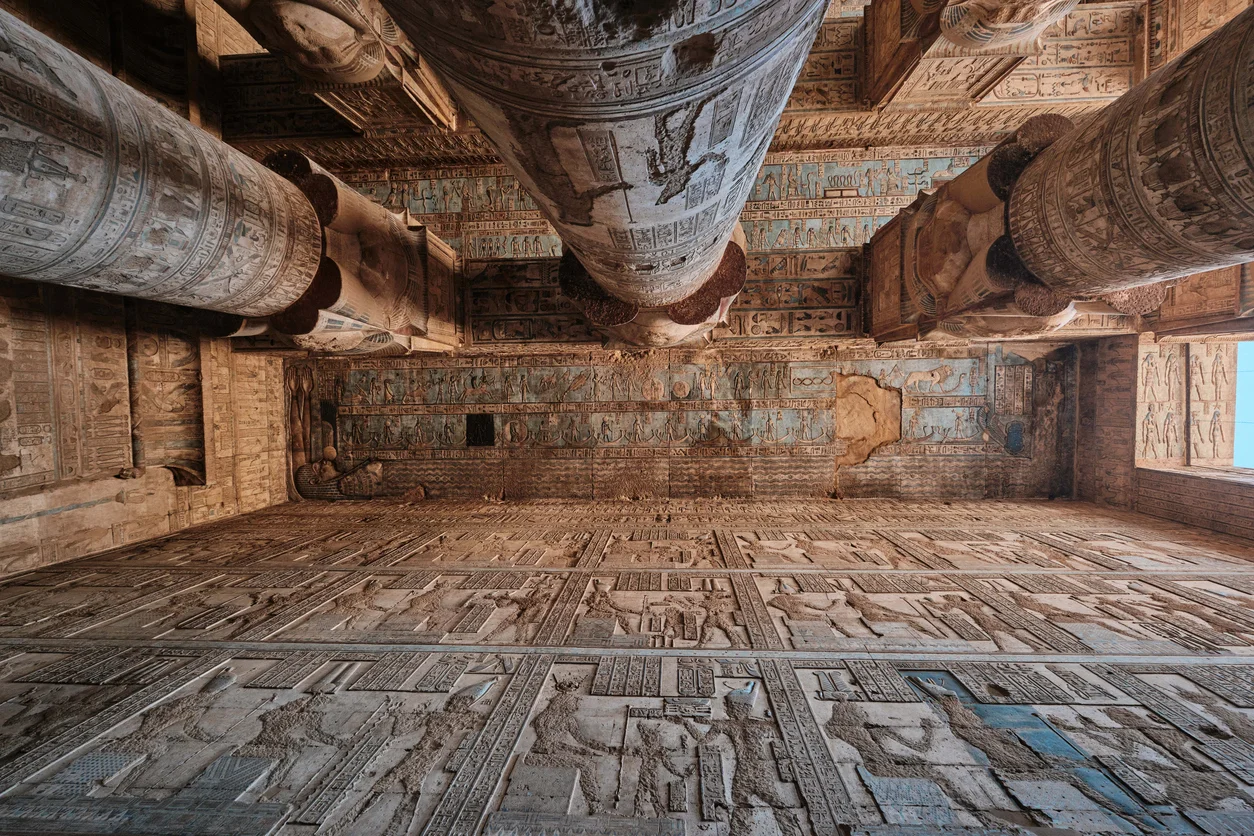
The Great Hypostyle Hall – Dendera Temple
Period: Constructed during the reign of Roman Emperor Tiberius in the 1st century AD, the hall reflects traditional Egyptian architectural styles.
Architectural Features:
- The hall has a nearly square layout; its entrance aligns with the path to the inner sanctuary.
- It houses 24 monumental columns, each crowned with intricately carved capitals shaped like Hathor’s image, featuring a female face paired with cow ears.
- Arranged in six rows of four columns, the structure exudes symmetry and grandeur.
- The ceiling is vibrantly adorned with astronomical motifs, illustrating constellations, stars, and celestial cycles of the sun and moon.
- Its surrounding walls depict Roman emperors, such as Tiberius, presenting offerings to Egyptian deities, symbolizing cross-cultural influences.
Decorative Highlights:
The ceiling: Esteemed as one of the finest examples of astronomical art in Egyptian temple design.
It portrays celestial bodies including planets, constellations, and solar and lunar rhythms.
One of its iconic panels the Dendera Zodiac has been relocated to the Louvre Museum in Paris.
The columns: The Hathor capitals are lavishly detailed, still showcasing remnants of ancient polychrome designs.
Significance of the Hypostyle Hall:
- Acknowledged as the most exquisite hypostyle hall among Roman-era Egyptian temples.
- It serves as a testament to the enduring legacy of Egyptian religious traditions during Roman rule.
- Illustrates a seamless fusion of Pharaonic artistic styles with Ptolemaic and Roman elements.
- Its brilliantly restored colors continue to captivate visitors, with restoration efforts initiated in 2010 and ongoing to date.
Religious Relevance
The hall functioned as a central space for priestly gatherings prior to access to the sanctuary. It played a pivotal role during major Hathor-dedicated religious festivities. Celestial inscriptions on the ceiling reinforce the temple’s connection to the cosmos and the overarching harmony of universal order.


The Astronomical Ceiling at the Dendera Temple
Tucked away within the Great Hypostyle Hall of the Temple of Dendera, dedicated to the goddess Hathor, lies one of the most captivating treasures of ancient Egypt the Astronomical Ceiling. This architectural masterpiece isn’t just a feast for the eyes but a window into how ancient civilizations viewed the cosmos.
What makes this ceiling particularly mesmerizing is its vivid polychromy, which has managed to withstand the test of time remarkably well. Its intricate artwork and inscriptions reveal humanity’s early attempts to decode the mysteries of the universe.
Featured on this celestial canvas are:
- – The cycles of the sun, moon, and stars in motion.
- – Planetary journeys across the zodiac constellations.
- – Mythical scenes depicting celestial deities steering solar boats across the heavens.
- – Texts and symbolic narratives recounting Ra’s diurnal and nocturnal passage across the skies.
Among the many stunning elements of the Astronomical Ceiling, the Dendera Zodiac holds a special allure. Carved onto a circular stone slab, this remarkable artifact presents all twelve zodiac signs Aries, Taurus, Gemini, and beyond paired with planets and stars.
This zodiac is more than an artistic triumph; it is historically significant. Recognized as the oldest complete depiction of the zodiac system, it embodies a convergence of ancient Egyptian astronomy with Greco-Babylonian influences. Scholars from Napoleon’s expedition discovered this treasure in 1799. Later, during the 19th century, it was transported to France and today resides in the Louvre Museum in Paris, where it continues to captivate visitors from around the globe.
What makes this zodiac so intriguing?
- – Its depiction of zodiac symbols mirrors the forms we use today.
- – It reflects an ancient snapshot of the sky’s alignment, dating back to around the 1st century BC or AD.
Restoring Ancient Brilliance
The Great Hypostyle Hall’s ceiling underwent extensive cleaning and restoration efforts between 2000 and 2019, bringing its original colors deep midnight blue and gleaming gold back to their radiant glory. This meticulous restoration has revitalized its ability to awe and inspire visitors, making it one of Egypt’s most sought-after attractions today.
(Whether you’re fascinated by astronomy, mythology, or simply the grandeur of ancient art, the Dendera Temple’s Astronomical Ceiling offers an unforgettable glimpse into humanity’s timeless relationship with the cosmos.)
The Crypts of the Dendera Temple
The Temple of Dendera stands out for its impressive architectural feature: twelve crypts ingeniously embedded within its thick walls. These crypts are distributed across different levels, with some located on the ground floor beneath the temple and others positioned on the roof. Their primary role was to serve as hidden sanctuaries, safeguarding sacred artifacts essential to ancient worship and rituals.
Functions of the Crypts
- – Housing divine statues crafted in gold and silver.
- – Storing liturgical items such as sacred crowns, vases, and ceremonial ornaments.
- – Preserving magical texts and papyri tied to mystical practices.
- – Facilitating ritual activities integral to religious observance.
Artistic Decoration
Several crypts feature intricate and colorful bas-reliefs that portray:
- – Protective deities guarding cosmic secrets.
- – Iconic scenes celebrating figures like Hathor, Isis, and Osiris.
Among the most renowned depictions is the enigmatic Dendera Light scene. Interpretations vary widely; while some speculate it represents an ancient electric lamp, Egyptologists often understand it symbolically, as an allegory for creation and the birth of the sun.
Notable Crypt Examples
- – The Western Crypt: Adorned with imagery related to Osiris and themes of resurrection.
- – The Crypt of the “Lamp”: Home to the famous Dendera Light illustration.
- – The Crypt of Statues: Likely used to store gilded statues of Hathor employed during religious processions.
Significance of the Crypts:
The crypts within the Dendera Temple are remarkable not only for their elaborate decorations but also for their sheer number, unmatched by other Egyptian temples. They highlight the temple’s dual role as both a public site of worship and a secretive haven for treasures and sacred knowledge.
( While some crypts remain inaccessible to visitors, portions of this hidden world have been opened to allow exploration into these fascinating structures steeped in ancient mystery. )


Exploring the Mammisi The Birth House at Dendera
In ancient Egyptian culture, the Mammisi, meaning “house of birth” in Coptic, held profound significance. These small and intricately designed structures were dedicated to celebrating the miraculous birth of a divine child, often connected to the main deity of the temple complex.
At Dendera, the Mammisi is uniquely tied to Hathor, the goddess of love, music, and joy, and her son Ihy, the god embodying music and jubilation. This particular Mammisi stands out not only for its artistry but also for its symbolic role in preserving profound aspects of Egyptian spirituality.
Location: Where History Lives
Nestled on the right side of the courtyard and positioned gracefully before the main pylon of the Dendera Temple, the Mammisi may be smaller than its grand counterpart but is no less captivating. Its modest scale belies how richly adorned it is a visual feast that draws visitors into its sacred purpose.
Decorations:
Both the interior and exterior walls of this fascinating structure are covered with elaborate depictions that come to life as visual narratives. These decorations immortalize:
- – Scenes of deities attending the sacred birth of Ihy, complete with intricate details that highlight moments of divine interaction.
- – Roman emperors such as Augustus and Tiberius presenting offerings with regal devotion, symbolizing their role as “legitimate kings” in Egyptian eyes.
- – Tender nursing moments where Hathor nourishes Ihy, embodying themes of fertility and renewal ingrained deeply in Egyptian belief systems.
(These stunning visuals blend religious ideology with artistic mastery, creating a timeless connection between divinity and earthly leadership.)
A House With a Purpose
The Mammisi at Dendera was more than just an architectural marvel; it played an active role in religious rituals. Annually, it served as the heart of celebrations honoring the birth of Ihy. These festivals symbolized renewal not just for royal power but also for Egypt’s unending cycle of life and fertility. The rituals performed within these walls underscored:
- – The rejuvenation of the king’s divine energy, paralleling Ihy’s eternal offering of strength and vitality.
- – The perpetuation of life in Egypt, solidifying the harmony between human society and cosmic order.
A Legacy Worth Celebrating
What sets Dendera’s Mammisi apart is its impeccable preservation and artistic richness, making it one of the most remarkable examples of its kind from the Ptolemaic and Roman periods. This small structure serves as a poignant reminder of traditions linking kingship to divine legitimacy through cosmic births a theme central to Egyptian religious philosophy.
Mammisis like these aren’t limited to Dendera alone. Other examples, such as those found at Philae, honor similar divine narratives, celebrating Isis and Horus in their celestial roles. These symbolic spaces continue to fascinate historians and travelers alike for their role in embodying ancient mythology and spiritual wisdom.
(For anyone seeking to connect deeper with Egypt’s history and its timeless blend of art, religion, and governance, the Mammisi remains a treasure worth exploring a captivating portal into a world where gods walked among mortals, and kings found strength through connection with the divine).
The Kiosk: A Resting Haven for Sacred Rituals
Nestled within the ancient world of Egypt’s temples, the kiosk. Often referred to as the Resting Place of the Bark, was a remarkable structure that carried great spiritual significance. This small, open building. Typically composed of columns supporting a roof functioned as a ceremonial stopover for sacred boats during grand religious processions.
These kiosks were strategically positioned either near the Nile’s landing stages or at temple entrances. Where they welcomed the arrival of the divine bark. A notable example is the bark of the goddess Hathor. Which would journey from the Temple of Edfu during festive occasions to be received at such kiosks. Adding to their sacred aura. These structures were adorned with intricate decorations portraying gods and kings greeting the procession or making offerings a visual representation of divine reverence and earthly devotion.
The Roman Propylea: Gateways to Glory
Standing in stark yet harmonious contrast to the kiosk are the Roman propylea. Monumental porticoes constructed during Rome’s reign over Egypt. Positioned prominently before the Temple of Dendera. These entrance towers were not just gateways; they symbolized power, unity, and artistic fusion.
Functionally:
the propylea served as grand entrances linking the outside world to the sanctity of the temple while. Showcasing reliefs of Roman emperors such as Tiberius, Claudius, Nero, and Domitian. Adorned in traditional pharaonic attire. Through these carvings. Roman rulers depicted themselves offering sacrifices to Egyptian deities, blending their rule with Egypt’s timeless spirituality and traditions.
Architecturally:
the propylea represented a union between two worlds: Egypt’s historical design aesthetic featuring massive gateways rich in intricate decorations and Rome’s imperial branding infused with iconic motifs that underscored authority. This synthesis spoke volumes about Rome’s strategy in legitimizing its control over Egypt by embracing and even elevating local heritage.
A Fusion of Ritual and Monumentality
Both the kiosk and propylea played unique yet interlinked roles in shaping Dendera’s spiritual and architectural identity. The kiosk bridged the temple with Nile-centered religious ceremonies, becoming an essential part of sacred processional routes a tradition echoed in similar structures, such as Trajan’s kiosk at Philae. Meanwhile, the propylea stood as visual proof of Roman dominance while symbolizing an integration of Egyptian symbolism to grant their rule divine credibility.


Sacred lake & sanatorium in Dendera
Most ancient Egyptian temples featured a sacred lake, and the Dendera Temple is no exception.
Functions:
- – Ritual purification of priests before entering the temple.
- – Ceremonies dedicated to Hathor, the goddess of the sky, water, and fertility.
- – Serving as a water reservoir for various religious practices.
The Sacred Lake at Dendera still exists today, characterized by its rectangular form and encircled by stone walls.
The Sanatorium
Adjacent to the lake, within the Dendera Temple complex, lies a building believed to be one of history’s earliest sanatoriums or hospitals.
Pilgrims and visitors came here seeking healing, relying on methods like:
- – Immersing in or consuming consecrated water.
- – Practicing incubation, where individuals would sleep in the building, hoping for a visionary dream from the goddess Hathor that would reveal a remedy.
- – Consulting medical recipes or prescriptions sometimes inscribed on the temple walls.


The Winding Staircase &The Roof – Dendera Temple
The Temple of Dendera stands as a fascinating gateway into ancient rituals and architectural ingenuity. Unlike many temples from its era, this sanctuary’s roof remains accessible to visitors, unveiling a unique perspective into its celestial connections and ceremonial significance.
A Journey to the Roof: Rituals and Worship
Ascending to this historical rooftop is an experience in itself. In ancient times, this elevated space played a pivotal role in rituals associated with solar worship and New Year festivities. It was here that priests performed sacred ceremonies under the open sky, connecting their divine practices to celestial forces.
The roof also features several small chapels, each brimming with history and myth:
Osiris Chapels: Dedicated to the cult of Osiris, these halls are adorned with intricate scenes that narrate the myth of resurrection a legend deeply rooted in ancient Egyptian beliefs.
Solar Worship Spaces: Positioned to honor the sunrise, these areas exemplify the temple’s profound connection to the solar disk, symbolizing renewal and cosmic harmony.
The Mesmerizing Corridors: A Sacred Maze
Step inside the temple, and you’ll find yourself surrounded by long, winding corridors skirting the sanctuary and inner chambers. These labyrinth-like passageways aren’t merely about architectural beauty they served distinct purposes:
Ritual Use: Enabling priests to circulate seamlessly during sacred ceremonies.
Practical Functionality: Providing access to crypts and hidden underground chambers.
Structural Support: Distributing the weight of the temple’s monumental design, ensuring stability across generations.
These corridors evoke a sense of mystery, reinforcing the idea of the temple as a “sacred maze” guiding pilgrims through layers of divine symbolism.
The Spiral Staircases:
Flanking the temple’s entrance are two spiral staircases, majestic in both form and function. These wide-ramped spiral paths seem to twist heavenward, offering more than just a practical means of climbing to the roof.
Ritual Significance: Priests ascended these stairways during divine processions, carrying sacred statues and offerings to the rooftop.
Solar Celebrations: Integral to Hathor’s sunrise ceremonies during New Year festivities, symbolizing her divine appearance.
Artful Depictions: The walls of these staircases are rich with reliefs portraying processions priests solemnly carrying sacred boats amidst ornate carvings that tell timeless stories.
Famous Artifacts and Their Transfers: What Happened to Dendera’s Treasures?
The Dendera Zodiac was relocated to France between 1821 and 1822. Initially displayed in the royal galleries before being moved to the national museum, it eventually found a permanent home at the Louvre. Today, only replicas of the zodiac can be seen at the Dendera site. This event remains one of the most notable examples of Egyptian antiquities being taken abroad during the 19th century.
In addition to the zodiac, various other artifacts and fragments, including items from statue caches, sculpted blocks, and reliefs, were transported to the Egyptian Museum in Cairo as well as several European museums. These transfers often followed archaeological excavations and explorations conducted during the same period.


Lesser-Known Insights and Anecdotes: Remarkable and Singular Facts from Dendera
Actual purpose of the crypts: Contrary to the popular perception of these spaces being “tombs,” the crypts at Dendera were actually sacred storerooms. They house remarkably detailed inscriptions outlining the process of creating divine statues, including specifications for their dimensions and materials—essentially serving as “technical manuals” for ritual objects. Such meticulous documentation is rarely found in other Egyptian temples.
An ancient Mammisi predating the main temple: While the prominent temple structure visible today dates back to the Ptolemaic and Roman periods, part of the Mammisi is linked to the rule of Nectanebo II in the 4th century BC. This illustrates the layered, cumulative nature of construction, where elements from various eras intertwine over time.
A hub for science and astronomy: The astronomical ceilings of Dendera stand out as invaluable resources for understanding religious astronomy in ancient Egypt, while simultaneously showcasing the integration of Greek and Roman influences during the Ptolemaic era. As such, Dendera serves as both a religious center and a cosmological observatory unlike any other.
A recent find in 2023: Excavation and restoration efforts unearthed a small lion sculpture featuring a cartouche attributed to Emperor Claudius. This discovery affirms the continuation of artistic and votive practices during the Roman period at the site, extending into the 1st century AD.


Tips for Visiting Dendera (Highlights Not to Miss)
The Temple of Dendera is renowned for the exceptional preservation of its reliefs and colors, often far better conserved than in other Egyptian sanctuaries.
Here are the must see highlights:
- The astronomical ceiling of the Great Hypostyle Hall: a unique masterpiece depicting the constellations, and the path of the sun, moon, and stars.
- The underground crypts (if open to the public): they contain inscriptions detailing the making of statues and sacred objects.
- The Mammisi (birth house): decorated with touching scenes illustrating the birth of the god Ihy, son of Hathor.
- The Dendera Zodiac: the original is housed in the Louvre, but on-site copies and explanations allow visitors to appreciate this cosmological masterpiece.
Tip: Take the time to observe the restored colors the shades of blue and gold reveal the temple’s deep symbolic richness.
Conclusion
The Temple of Dendera stands as a remarkable testament to the blending of history and culture, showcasing centuries of architectural evolution. Originating in the time of the Pharaohs and later enriched by Ptolemaic and Roman influences, this extraordinary complex weaves together unique threads of religious, astronomical, and ceremonial significance. Additionally, its contributions to European Egyptology, particularly the renowned Dendera Zodiac, have left an enduring mark on scientific exploration and understanding.
Temple of Dendera
Sanctuary of Hathor – One of Egypt’s Best-Preserved Temples
What is the Temple of Dendera?
The Temple of Dendera, originally known as Iunet or Tentyra, is one of the most well-preserved temple complexes in Egypt. Located on the eastern bank of the Nile near Qena, about 60 km north of Luxor, it was dedicated to Hathor, the goddess of love, music, joy, and motherhood.
Built primarily during the Ptolemaic period and completed under Roman rule, its vibrant reliefs, crypts, and astronomical ceiling make it a masterpiece of ancient Egyptian religious architecture. Enclosed by a massive mudbrick wall, the site has been a sacred center for millennia.
When was the temple built?
The current structure dates back to the Ptolemaic period, with construction beginning around 54 BC under Ptolemy XII Auletes. Work continued through the reign of Cleopatra VII and into the Roman era.
The famous hypostyle hall was added by Emperor Tiberius in the 1st century AD, blending Ptolemaic design with Roman craftsmanship.
Who built the Temple of Dendera?
The main construction was led by the Ptolemies, especially Ptolemy XII and Cleopatra VII. The Romans, particularly Emperor Tiberius, contributed significantly—especially to the grand hypostyle hall.
This collaboration created a unique fusion of Egyptian, Greek, and Roman artistry, making Dendera a symbol of cultural continuity.
What are the key architectural features?
- Hypostyle Hall: 24 columns with Hathor-headed capitals, astronomical ceiling.
- Crypts: 12 underground chambers for storing sacred objects.
- Mammisi (Birth House): Celebrates the divine birth of Ihy, son of Hathor.
- Sacred Lake & Sanatorium: For purification and healing rituals.
- Kiosk & Propylea: Roman-era gateways and resting places for sacred boats.
The temple remains enclosed by a massive mudbrick wall, preserving its original layout.
Why is the roof accessible?
Unlike most temples, Dendera allows visitors to climb the roof via spiral staircases. This elevated space was used for solar rituals and New Year celebrations.
It features small chapels dedicated to Osiris and solar worship, reinforcing the temple’s connection to the cosmos.
What is the Astronomical Ceiling?
Located in the Great Hypostyle Hall, this ceiling is one of the finest examples of ancient Egyptian astronomy. It depicts:
- Celestial bodies, stars, and planetary cycles.
- The sun god Ra’s journey across day and night skies.
- The Dendera Zodiac — a circular depiction of the 12 zodiac signs and planets.
The colors were restored between 2000–2019, revealing deep blue and gold hues that mimic the night sky.
Where is the Dendera Zodiac now?
The original Dendera Zodiac was removed in 1821–1822 and is now displayed at the Louvre Museum in Paris.
A replica remains at the site. Its removal is one of the most famous cases of antiquities taken from Egypt during the 19th century.
Are there tombs inside the temple?
No. The temple was not a tomb. However, it contains 12 crypts — hidden chambers beneath the floors and on the roof.
These served as secure storerooms for:
- Sacred statues of Hathor (some made of gold).
- Ritual objects, crowns, and magical texts.
- Inventory inscriptions detailing how to craft divine items.
One crypt features the mysterious “Dendera Light” carving, often interpreted symbolically as the birth of light or creation.
What is the Mammisi at Dendera?
The Mammisi (“birth house”) celebrates the divine birth of Ihy, the child of Hathor and Horus.
Decorated with scenes of gods attending his birth and Roman emperors like Augustus and Tiberius making offerings, it was central to annual festivals of renewal.
Interestingly, part of it dates back to Nectanebo II (4th century BC), predating the main temple.
Was there a hospital at Dendera?
Yes. Adjacent to the sacred lake is a building believed to be one of history’s earliest sanatoriums.
Pilgrims came here seeking healing through:
- Drinking or bathing in consecrated water.
- Incubation: Sleeping in hopes of receiving healing dreams from Hathor.
- Reading medical prescriptions inscribed on walls.
This shows Dendera’s role as a center of spiritual and physical healing.
Any recent discoveries?
In 2023, a small lion sculpture bearing a cartouche of Emperor Claudius was discovered during restoration work, proving continued Roman activity at the site into the 1st century AD.
Is Dendera an astronomical observatory?
While not an observatory in the modern sense, Dendera reflects advanced knowledge of celestial cycles. Its astronomical ceiling combines Egyptian cosmology with Greco-Babylonian zodiac systems, making it a vital resource for understanding ancient science and religion.
| Feature | Detail |
|---|---|
| Main Deity | Hathor – Goddess of Love, Music, and Motherhood |
| Location | East Bank of the Nile, near Qena, Egypt |
| Construction Period | Ptolemaic (~54 BC) to Roman Era (1st century AD) |
| Main Patrons | Ptolemy XII, Cleopatra VII, Emperor Tiberius |
| Famous For | Astronomical ceiling, Dendera Zodiac, crypts, Mammisi |
| Unique Feature | Best-preserved Roman-era hypostyle hall in Egypt |
| Original Zodiac Location | Now in the Louvre Museum, Paris |
| Special Rituals | Healing incubation, solar ceremonies, divine processions |


