

Hatshepsut: The Woman Who Entered Pharaonic History with the Steps of a Goddess
Introduction:
Throughout the annals of ancient Egypt, numerous pharaohs have left their marks through grand statues and elaborate tombs. However, Hatshepsut stood out by crafting a distinct narrative during her reign. One characterized by astute strategy, rich symbolism, and a keen understanding of historical legacy. Rather than fitting the mold of a conventional queen, she boldly became the first woman to claim the. Throne and wield it with exceptional intellect.
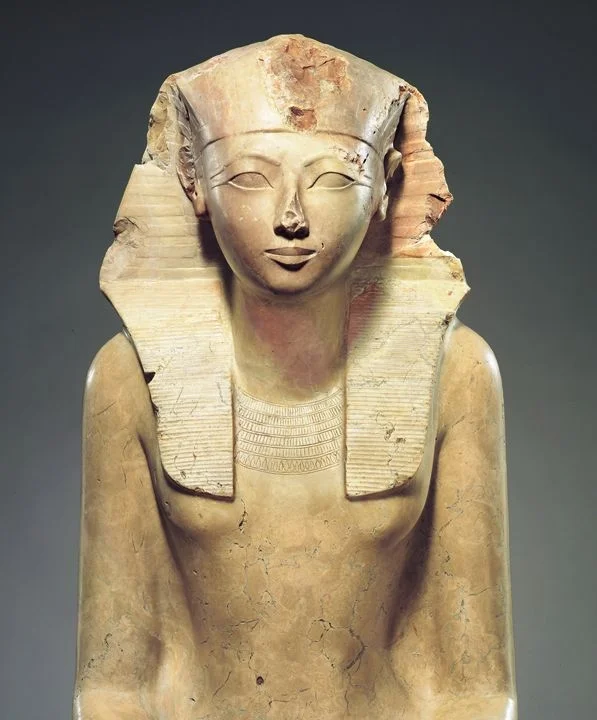
Hatshepsut: Her Birth and Claim to the Throne – An Intriguing Political Narrative
Full name: Maatkare Hatshepsut, which translates to “the sacred union of Ma’at (justice) with the spirit of Ra.”
As the daughter of King Thutmose I and his principal wife, Ahmose, Hatshepsut boasted an unblemished royal lineage. This stands in contrast to her half-brother, Thutmose II, who was born to a secondary wife.
An interesting note: While her husband Thutmose II ascended to the position of pharaoh, he lacked the. Strength of character to effectively lead. Consequently, Hatshepsut began to assert her political influence even during his reign.

Secondly: How Did Hatshepsut Proclaim Herself Pharaoh?
Following the passing of Thutmose II, the rightful heir, Thutmose III, was still a young child, while. Hatshepsut initially held the title of “regent of the throne.”
Within just seven years, she expertly restructured the institutions of religious power, aligning herself with the influential priests of Amun. Through their support, she proclaimed herself the daughter of the god. Amun, which paved the way for her to be crowned with full pharaonic rites.

Interesting Fact:
Hatshepsut persuaded the priests that Amun had taken the form of her father, Thutmose I, to unite with. Her mother. This bold claim positioned her not only as the daughter of a king but as the direct daughter. Of the god Amun—a remarkable assertion in Egyptian history.
Thirdly: Rare and Exceptional Instruments of Power
1.Symbolic Visual Propaganda
Hatshepsut didn’t just present herself as a male; there were moments when she adorned herself in. Traditional feminine clothing, showcasing a soft countenance while donning the pharaonic beard. This was her way of proclaiming: “I am the king, regardless of your opinions.”

Interesting Insight:
In a statue featured at the Metropolitan Museum, Hatshepsut is depicted with unmistakably feminine traits while wearing the complete royal crown. This striking combination was intentionally crafted to challenge her adversaries and convey a significant message: power transcends gender.
2.Innovative Economic Ventures in Ancient Egypt
Hatshepsut is renowned for organizing the first significant trade expedition to the Land of Punt, marking a pivotal moment that combined both economic growth and diplomatic relations.
This groundbreaking expedition yielded a wealth of treasures, including gold, ebony, perfumes, incense, exotic animals, and even various plants that were later nurtured in her temples.

Did you know?
Bas-reliefs in her temple illustrate the planting of myrrh trees, representing the earliest known instance of cultivating an imported plant in Egyptian history. This makes Hatshepsut a trailblazer in blending international agriculture with the economy of ancient Egypt.
3.Architecture as a Statement of Power
The mortuary temple of Deir el-Bahari served not just as a tomb but also as a hub of political and spiritual significance.

Hidden insight:
The temple features a groundbreaking three-tiered design, a first in Egyptian architecture, with its axes oriented towards the star Sirius (Sopdet). This star was connected to the annual flooding of the Nile and the start of the Egyptian New Year. Essentially, the temple functioned as an intricate astronomical calendar, cleverly embedded in its very construction.
Fourthly: Her Intriguing Connection with Architect Senenmut – A Deeply Personal Tie
Senenmut served as Hatshepsut’s architect and was a trusted advisor, managing many of her architectural endeavors.
In statues, he is often depicted with Princess Neferure, Hatshepsut’s daughter, which hints at a bond of profound trust and perhaps an intimate relationship.
A rare and intriguing detail:
Among his unfinished tombs is a concealed passage that leads straight to Hatshepsut’s tomb. This intriguing feature has fueled much speculation about their connection and the exclusive access he might have had to her resting place after her death, yet no one has ever discovered his remains.

Fifthly: Her Erasure from History and Disappearance
Following her passing, Thutmose III ordered the removal of her name from temples and the destruction of her statues.
Not Just Revenge, Contrary to Common Belief:
Recent research indicates that this erasure stemmed not from animosity but from a need to reinforce male dynastic continuity. A queen ruling as pharaoh could have empowered future claims by women to power, posing a direct challenge to the entrenched patriarchal structure.

The Discovery of Hatshepsut’s Mummy and the Enigma of the “Missing Tooth”
In 2007, Dr. Zahi Hawass made a remarkable announcement: he successfully identified Hatshepsut’s mummy among a collection of unidentified remains.
The confirmation came from a tooth discovered in a wooden box inscribed with her name, which fitted seamlessly into a gap in the mummy’s jaw.

Interesting scientific insight:
CT scans uncovered that Hatshepsut had been suffering from type 2 diabetes, liver issues, and bone. Cancer, ailments that likely led to her death at around sixty-five years old. Quite an impressive lifespan for a pharaoh of her time.
Hatshepsut – The Game of Power and Sacred Text
Hatshepsut was more than just a female ruler of ancient Egypt she was a masterful strategist in communication and symbolism. By cleverly integrating religion, art, diplomacy, and architecture. She fortified her claim to be one of the most powerful figures in the ancient Near East.
Each monument she erected and every statue she commissioned relayed a powerful message:
“I am the daughter of the gods, I am Pharaoh, and there is no turning back.”

Exploring Hatshepsut’s Temple: A Journey Through Time and Space
📍 Location of Hatshepsut’s Temple
Here’s a revised version without passive voice:
“Hatshepsut’s mortuary temple sits in Deir el-Bahari, just west of Luxor, along the western bank of the Nile at the foot of the majestic Theban cliffs.
Here’s a revised version without passive voice:
This remarkable structure showcases three grand stepped terraces, which ramps elegantly connect, demonstrating one of the most impressive architectural feats of ancient Egypt.
What Can Be Found Inside the Temple?
- The Holy of Holies: This is the most sacred area of the temple, where worship of the god Amun-Ra. Takes center stage, creating an atmosphere of reverence and devotion.
- The Chapel of the Goddess Hathor: Featuring stunning columns shaped like cow heads, this chapel. Celebrates Hathor, the goddess of love and motherhood, offering visitors a glimpse into the rich Symbolism of ancient beliefs.
- Reliefs of the Expedition to the Land of Punt: Here, you can see detailed carvings commemorating. Hatshepsut’s legendary trade mission, one of the earliest recorded diplomatic endeavors in history.
- The Divine Birth Hall: This area narrates the myth surrounding Hatshepsut’s birth, portraying her as. The daughter of Amun to legitimize her reign and assert her divine right to rule.
- Damaged Remains: Following Hatshepsut’s death, Thutmose III took measures to erase certain. Inscriptions and destroy her statues, attempting to undermine her historical significance.
Rare Fact:
The temple is astronomically aligned to mark the sunrise on the sacred Opet festival, which symbolizes. The profound connection between the king and the deity, particularly on that important date.


Hatshepsut’s Archaeological Artifacts: Where Are They Now?
– More than 20 statues of Hatshepsut are proudly displayed at the Metropolitan Museum of Art in New. York.
– Her remarkable canopic jars, exquisite jewelry, amulets. And various pieces of funerary furniture can be. Found preserved between the Grand Egyptian Museum (GEM) and the Egyptian Museum in Cairo (the older museum).
– Among these treasures. The box containing her tooth stands out as an iconic artifact. Representing a Significant achievement in modern archaeology.
Unveiling Her Tomb and Rediscovery Timeline
– Hatshepsut’s original tomb, KV20, nestled in the Valley of the Kings, is notable for its depth, extending over 200 meters.
– This remarkable site was unearthed in 1903 by the well-known British archaeologist Howard Carter.
– After the erasure of her legacy, it’s believed her mummy was covertly relocated to her nurse’s tomb (KV60) for safekeeping.
Interesting Tidbits:
– Priests from the 21st Dynasty are thought to have made secretive efforts to re-bury her mummy to. Protect it from looters, similar to the actions taken for Ramses II.
– Within KV20, two stunning pink granite sarcophagi were found—one designated for Hatshepsut and. The other for her father, Thutmose I. illustrating her wish to be interred next to her father. Rather than her husband.
Conclusion
Hatshepsut’s temple stands not just as a funerary monument; it serves as a vivid testament to her philosophy of power, her political acumen, and her profound understanding of religion.
Her mummy, long forgotten until rediscovered through a solitary tooth, encapsulates the intricate dynamics of her time and showcases the brilliance and audacity of this extraordinary woman whose legacy continues to inspire.
History could not erase her impact. Hatshepsut challenged the passage of time—and emerged victorious.
Frequently Asked Questions About Queen Hatshepsut
The Female Pharaoh Who Ruled Like a God
Who was Hatshepsut?
Hatshepsut was one of the most powerful and successful female pharaohs in Egyptian history. She ruled during the 18th Dynasty (c. 1479–1458 BCE) and was the second historically confirmed female pharaoh, after Sobekneferu.
Unlike queens who ruled as regents, Hatshepsut officially proclaimed herself **Pharaoh**, adopting the full titles, regalia, and iconography of kingship — including the false beard, kilt, and double crown of Upper and Lower Egypt.
What does her name mean?
Her full name was Maatkare Hatshepsut, which means:
- Maat: Truth, justice, and cosmic order.
- kare: “Spirit of Ra” (the sun god).
- Hatshepsut: “Foremost of Noble Ladies” or “She is foremost among the women.”
Together, her name declares her divine right to rule and her role as a bringer of balance and light.
How did Hatshepsut become pharaoh?
Hatshepsut was the daughter of Thutmose I and his chief wife, Ahmose. She married her half-brother, Thutmose II, and became Great Royal Wife.
When Thutmose II died, his son by a secondary wife, Thutmose III, was too young to rule. Hatshepsut became **regent** — but within seven years, she elevated herself to full pharaoh with the support of the powerful priests of Amun.
How did she justify her rule as a woman?
Hatshepsut claimed that the god Amun had taken the form of her father, Thutmose I, and fathered her. This divine conception was depicted in reliefs at her temple at Deir el-Bahari, where the god is shown breathing the “breath of life” into her mother.
This bold claim positioned her not just as a royal daughter, but as the **direct offspring of a god**, giving her the divine right to rule.
What was Hatshepsut’s most famous achievement?
Her most famous achievement was the **expedition to the Land of Punt** — a legendary trading mission that brought back exotic goods like:
- Gold, ebony, and ivory
- Frankincense and myrrh trees
- Live apes, baboons, and leopards
- Precious perfumes and resins
The journey is immortalized in detailed reliefs at her mortuary temple, showing the ships, people, and even the planting of myrrh trees in Egypt — the earliest known example of international plant cultivation.
What is the Mortuary Temple of Deir el-Bahari?
The **Temple of Deir el-Bahari** is Hatshepsut’s masterpiece — a stunning three-tiered structure built into the cliffs of western Thebes. Designed by her architect Senenmut, it was revolutionary in design and symbolism.
Its axes are aligned with the star Sirius (Sopdet), which signaled the Nile flood and the New Year. This made the temple not just a religious site, but an **astronomical calendar**.
It served as a place of worship, political propaganda, and eternal resting place, blending architecture, religion, and power.
Did Hatshepsut lead military campaigns?
Unlike many pharaohs, Hatshepsut focused on **peace, trade, and construction** rather than war. However, she did conduct minor military actions to secure trade routes and maintain order.
Her reign was marked by internal stability, economic prosperity, and monumental building projects — a golden age for Egypt.
Why is Hatshepsut shown as a man in statues?
In many statues and reliefs, Hatshepsut is depicted with a **false beard, kilt, and muscular male body** — the traditional image of a pharaoh. This was a deliberate act of political propaganda to assert her legitimacy in a male-dominated role.
However, her face often retains **feminine features** — soft cheeks, narrow chin — suggesting a nuanced message: she was both king and woman, transcending gender to fulfill her divine duty.
Was Hatshepsut’s image always masculine?
No. In some depictions, especially early in her reign, she is shown in **traditional feminine attire**. Even in statues where she wears the pharaoh’s crown and beard, her body is sometimes slender and graceful.
One famous statue in the Metropolitan Museum of Art shows her with a clearly female face and form, yet wearing full royal regalia — a powerful statement that power transcends gender.
Who was Senenmut?
Senenmut was Hatshepsut’s most trusted advisor, architect, and steward. He designed her mortuary temple and held over 20 titles, including “Steward of the King” and “Chief Architect.”
Some scholars believe he was also the tutor of her daughter, Neferure. His close relationship with the queen has led to speculation about a personal bond, though no definitive evidence exists.
Did Hatshepsut have children?
Yes. Hatshepsut had one daughter, Neferure, with her husband Thutmose II. Neferure was raised as a princess and may have been groomed for a prominent role, possibly as a future queen or high priestess.
After Hatshepsut’s death, Neferure disappears from records, suggesting she may have died young.
Why was Hatshepsut erased from history?
After her death, her stepson and successor, Thutmose III, ordered the systematic removal of her name and images from temples and monuments. Statues were smashed, reliefs chiseled out, and her cartouches erased.
For decades, it was believed this was an act of revenge. However, modern scholars suggest it was likely to **reinforce male dynastic continuity** and prevent future challenges to the patriarchal system.
How was Hatshepsut rediscovered?
Hatshepsut’s legacy was rediscovered in the 19th and 20th centuries through archaeological work at Deir el-Bahari and the Valley of the Kings.
In 1903, Howard Carter found a **granite sarcophagus** in KV20 bearing her name. Later, in 2007, a mummy found in KV60 was identified as Hatshepsut through DNA and a tooth matching a box bearing her name.
Where can I visit Hatshepsut’s temple?
The **Mortuary Temple of Hatshepsut at Deir el-Bahari** is located on the West Bank of Luxor, near the Valley of the Kings. It is one of the most visited sites in Egypt and a masterpiece of ancient architecture.
You can see:
- The three grand terraces rising from the desert.
- Reliefs of the Punt expedition and her divine birth.
- The sanctuary dedicated to Amun-Ra.
Where is Hatshepsut’s tomb?
Hatshepsut was buried in **KV20** in the Valley of the Kings, the oldest and deepest tomb in the valley. It was originally intended for her father, Thutmose I, but she expanded it for herself.
Her mummy was later moved for safety and was found in **KV60**, now displayed in the National Museum of Egyptian Civilization in Cairo.


