

Karnak Temple: A Detailed and Comprehensive Guide to Its History, Construction, Landmarks, Hidden Secrets, and Fascinating Anecdotes
Introduction
The Temple of Karnak, originally called Ipet-isut or “the chosen place,” stands as the largest religious complex of the ancient world. For over two millennia, it served as a cornerstone of worship and political power in Thebes-Waset, now known as Luxor. Spanning eras from the Middle Kingdom to the New Kingdom, and extending through the Ptolemaic and Roman periods, the temple cannot be credited to any single pharaoh. Instead, it reflects the collective legacy of successive kings and their ongoing projects across centuries.

The Beginning Of The Construction And Who Ordered It? (The Main Historical Stages)
Karnak truly flourished during the New Kingdom when Thebes rose to prominence as Egypt’s unified capital. This era saw sweeping expansions led by some of Egypt’s most influential figures. Including Amenhotep I, Thutmose I, Thutmose III, Hatshepsut. And later monumental builders like Amenhotep III, Seti I, and Ramses II, along with their successors. Among its many architectural marvels, the sanctuary dedicated to Amun-Re and the epic hypostyle hall emerged as standouts, dominating the 18th and 19th Dynasties with their grandeur.
The Ptolemaic and Roman periods continued this legacy, albeit in more modest forms. These later rulers focused on restoring existing structures and adding decorative flourishes to halls and interiors. From its first foundations to centuries of later modifications, Karnak represents a continuous narrative of devotion, artistry, and the ambition of countless leaders not just the vision of a single sovereign. Its enduring history makes it a masterpiece of ancient architecture, evolving with every generation that sought to leave their mark.

Where Was The Karnak Temple Built And Why Here? (The location)
The Temple of Karnak is located to the east of the Nile River, in the area of modern-day Thebes, now known as Luxor. It stands opposite the necropolis situated on the river’s west bank. Its ancient name, Ipet-isut, translates to “the most sacred place” in Egyptian, reflecting its dedication to the god Amun-Re.
This specific site was selected because Amun was the prominent local deity of the region. When Thebes became the capital and the cult of Amun gained significance, Karnak evolved into Egypt’s central religious hub.

Timeline Of The Kings’ Contributions To The Karnak Temple
| Period / Dynasty | Pharaoh | Approximate Reign | Main Contributions to Karnak |
|---|---|---|---|
| Middle Kingdom – 12th Dynasty | Senusret I | 1971–1926 BC | Construction of the White Chapel (Chapelle Blanche) – first permanent stone structure at Karnak |
| New Kingdom – 18th Dynasty | Thutmose I | 1506–1493 BC | Expansion of the temple, construction of early porticoes, establishment of the east–west axis |
| Hatshepsut | 1479–1458 BC | Construction of the Red Chapel, erection of two monumental obelisks (one still standing) | |
| Thutmose III | 1479–1425 BC | Construction of the Festival Hall (Akh-menu), military inscriptions recounting his Asian campaigns | |
| Amenhotep III | 1390–1352 BC | Creation of a southern temple dedicated to Amun, additional columns and chapels | |
| Akhenaten | 1352–1336 BC | Temples dedicated to Aten (later destroyed, stones reused in porticoes) | |
| New Kingdom – 19th Dynasty | Seti I | 1290–1279 BC | Initiated construction of the Great Hypostyle Hall |
| Ramses II | 1279–1213 BC | Completion of the decoration of the Hypostyle Hall, colossal statues, reliefs of the Battle of Kadesh | |
| New Kingdom – 20th Dynasty | Ramses III | 1184–1153 BC | Construction of the Temple of Khonsu within the Karnak complex |
| Late Period – 25th Dynasty | Shabaka | 716–702 BC | Architectural restorations and additional inscriptions |
| Taharqa | 690–664 BC | Erection of monumental columns in the first court (21 m high) | |
| Ptolemaic Period | Ptolemaic kings | 323–30 BC | Decorative additions and small chapels, maintenance of rituals |

The Design Of The Complex And The Main Areas What Can Be Seen At Karnak?
Karnak is not merely a single temple; it is an extensive complex featuring sanctuaries, courtyards, and grand porticoes. Some of the most notable areas include:
The entrance and the first pylons (Pylons I–III) — the access facade
Overview: This section features a series of imposing gateways, known as pylons, arranged along the longitudinal axis of the complex. Each pylon serves as the outer face representing distinct royal eras.
Construction and Timeline: The oldest pylons date back to the reigns of the 18th Dynasty, while subsequent ones were added during the 19th and 20th Dynasties by monarchs such as Seti I, Ramses II, and Ramses III.
Architectural Details: These structures are remarkable for their impressive height and thickness, often extending several tens of meters. Their surfaces are adorned with intricate reliefs depicting military achievements and religious iconography. Historically, the first pylon symbolized the starting point of processions moving from the southern direction toward the main sanctuary.
Archaeological Insights: The interiors of these pylons were constructed using repurposed blocks from older monuments. This approach enabled archaeologists to piece together remnants of earlier historical periods, including fragments attributed to Akhenaten.

The Great Hypostyle Hall
Description: Known as the iconic “forest of columns,” this awe-inspiring hall houses 134 towering columns, making it one of the most remarkable spaces within Karnak’s temple complex.
Construction: The project began under Pharaoh Seti I and was later completed and embellished by Ramses II. Its construction spans the 19th and 20th Dynasties, dating back to approximately the 13th century BC.
Dimensions: The hall stretches approximately 103 meters long by 52 meters wide. Twelve central columns rise impressively to nearly 20 meters in height, with capitals measuring between 3.5 and 4 meters in diameter.
Decoration: Intricate carvings and inscriptions adorn the surfaces, depicting processions, royal cartouches, ritual texts, and sacred imagery. The ceiling features star motifs and funerary texts inspired by the Book of the Dead.
Cultural Significance: This hall represents the pinnacle of ancient Egyptian religious art and served as a focal point for the grand ceremonies of the Opet Festival.
Remarkable Detail: Scientific studies have revealed that artists originally painted many inscriptions in vibrant hues using natural pigments, such as lapis lazuli blue and golden yellow.This suggests its original appearance was strikingly colorful, starkly contrasting with the gray stone seen by visitors today.


The Sacred Lake of Karnak
Purpose: The lake served as a site for ritual purifications. Priests, and symbolically the gods, navigated its waters during ceremonial processions, enhancing its divine and ceremonial significance.
Design: Situated to the east of the Great Hypostyle Hall, the lake features a rectangular shape with slightly curved sides. Its depth and surface were optimized for storing water used both for drinking and sacred rituals.
Notable Features: Archaeological investigations have uncovered remnants of ritual offerings and small votive artifacts at the lakebed. Engineers implemented an ingenious drainage system to maintain water quality, and some research suggests that the temple may have had systems for advanced water resource management.
The Festival Hall of Thutmose III (Akh-menu)
The Festival Hall of Thutmose III (Akh-menu) stands as one of the key architectural gems within the Karnak temple complex, blending grandeur, history, and ceremonial significance. Constructed during the reign of Thutmose III, this hall serves not only as a testament to ancient Egyptian craftsmanship but also as a repository of valuable historical insights. Among its notable features is the “Karnak King List,” an intricate inscription that chronicles the pharaohs’ lineage. While it provides a vital resource for understanding dynastic chronology, it deliberately emphasizes certain rulers while omitting others a reflection of the political and religious dynamics of the era.
The hall’s design exudes both functionality and symbolic import, embodying the essence of royal succession and rituals associated with the Opet Festival. This annual event celebrated the revitalization of the king’s divine authority, further connecting the ruler with Amun-Re, the chief deity. Ritual spaces within Akh-menu resonate with this theme, creating a spiritual ambience steeped in tradition.
One of the more intriguing aspects of the Karnak King List lies in its fragmentation over time. Today, pieces of this historical record reside in Western museums, offering glimpses into ancient Egyptian political ideologies and practices. These inscriptions also bear marks of intentional erasures, hinting at shifts in power and ideological purges that shaped the narrative.


The Secondary Temples of the Karnak Complex
The Karnak Temple Complex is a vast and awe-inspiring site, brimming with history and symbolism. While the grand temple of Amun-Re often takes center stage, the secondary temples provide fascinating insights into the diverse facets of ancient Egyptian spirituality. These smaller, yet equally impactful sanctuaries showcase the artistry, devotion, and cultural depth of their time. Let’s delve into three remarkable gems: the temples of Khonsu, Mut, and Ptah.
The Temple of Khonsu
Tucked within the vast Karnak complex, the Temple of Khonsu stands as a tribute to the lunar god Khonsu and offers visitors a unique glimpse into ancient Egyptian religious practices.
Constructed primarily during the 20th Dynasty under the reign of Ramses III and his successors, this secondary temple features architectonic layers from earlier rulers, demonstrating centuries of craftsmanship and devotion. While the Karnak site as a whole is a marvel, the Temple of Khonsu shines as one of its best-preserved structures, providing an unparalleled window into the past.
Archaeologists are especially thrilled about the temple’s state of preservation, which boasts complete sequences of reliefs and inscriptions. This rare level of intactness not only allows for detailed observation of its original layout and decoration but also grants experts an invaluable opportunity to understand the organization of cultic spaces and iconography in ancient Egypt a feat often hindered by damage elsewhere in the complex.


The Temple of Mut
Dedicated to Mut, the divine protector and consort of Amun, this temple presents an equally rich history. First established during the 18th Dynasty, it underwent significant expansion under the Kushite reign of the 25th Dynasty, particularly during the time of Pharaoh Taharqa.
Surrounded by a crescent-shaped sacred lake, the site holds mystical allure. Archaeologists have uncovered hundreds of statues of Sekhmet, a lion-headed goddess closely linked to healing and fertility. These statues were likely mass-produced as votive gifts in large-scale ritual campaigns aimed at combating epidemics. The Temple of Mut stands as a powerful reminder of humanity’s efforts to harmonize spirituality with physical well-being in turbulent times.


The Temple of Ptah
While more modest in scale compared to its counterparts, the Temple of Ptah offers a unique charm rooted in its connection to Memphis, Ptah’s original center of worship. First constructed under Thutmose III, it later saw substantial restorations during the Ptolemaic period—a testament to its enduring significance.
What sets this temple apart are its rare reliefs that document the intertwined religious traditions of Thebes and Memphis. Additionally, the temple features an intriguing depiction of Ptah-Pataikos, where he is represented as a dwarf a rarity in Theban iconography. This symbolic fusion underscores Egypt’s ability to blend regional cults into a cohesive spiritual landscape.


A Journey Through Time and Faith
The secondary temples of Karnak might not command the same awe as Amun-Re’s towering columns and obelisks, but they tell their own enchanting stories. Whether through preserved architectural grandeur, ritualistic symbolism, or uncommon iconography, these temples invite us to explore lesser-known aspects of ancient Egypt’s spiritual heritage. Make sure you pause at these hidden wonders on your next journey to Karnak they hold mysteries waiting to be rediscovered!

The Sanctuary of Amun-Re (Inner Sacred Chamber)
Overview: Recognized as the spiritual core of Karnak, this chamber housed the sacred barque of Amun, embodying the temple’s most revered purpose.
Origins: Initially constructed during the reign of Thutmose III, the sanctuary underwent significant restoration and expansion under various rulers, particularly in the Ptolemaic era.
Purpose: Reserved solely for the king and priests, it served as the site for daily rituals and prayers dedicated to the deity.


The Avenue of Sphinxes
The Avenue of Sphinxes serves as a grand processional route connecting the Temple of Karnak to the Temple of Luxor, stretching through what is now the main thoroughfare of the modern city. This majestic path is flanked by symmetrical rows of sphinx statues, featuring either ram heads or human heads, positioned on both sides of the avenue.
Dating back to the pharaonic era, the avenue’s origins lie in ancient history, though it was buried and inaccessible for centuries. Over time, it has undergone rediscovery and restoration efforts, with segments reopened in the 21st century to welcome visitors and host contemporary processions.
An intriguing aspect of the avenue is its sphinx statues, some of which bear inscriptions or symbols linked to various pharaohs. These markings reveal that the avenue was repurposed and modified across successive reigns, showcasing a remarkable continuity of rituals spanning several centuries.
The Chapels and the Open-Air Museum (Open-Air Museum / White Chapel)
The Chapels and the Open-Air Museum highlight important historical and architectural aspects, such as the White Chapel of Senusret I, which has been reconstructed within Karnak’s Open-Air Museum. This museum holds numerous architectural fragments from former structures, carefully reassembled to serve as educational exhibits.
The primary objective of this work is to showcase dismantled architectural elements that were either repurposed as filler material or left abandoned. These pieces are now contextualized to explain their historical significance and structural designs.


Notably: this reconstruction effort has enabled archaeologists to uncover the origins of previously “lost” blocks and determine their original locations within the temple’s monuments, shedding light on the temple’s layout and history.
The Majestic Obelisks
Standing as timeless monuments to human ingenuity and devotion. The obelisks of ancient Egypt are some of history’s most fascinating architectural marvels. Crafted from striking red granite sourced from Aswan. These towering monoliths command attention with their impressive dimensions. Sometimes rising to a height of approximately 29.5 meters and weighing an awe-inspiring 320 tons.
One iconic example is the Obelisk of Thutmose I. While one of its counterparts was later relocated. The original still proudly stands at Karnak, serving as a testament to its enduring legacy.
Obelisks were far more than grand stone structures; they held profound symbolic significance. Representing the solar rays and closely linked to the sun god Re. These monolithic creations were strategically placed in front of pylons or nestled within temple courtyards. Their positioning enhanced their spiritual and architectural impact. Creating an atmosphere of divine presence and celestial connection at these sacred sites.
Among the most notable is the still-standing obelisk of Queen Hatshepsut. Which rises as an emblem of both artistry and devotion. This extraordinary piece was once topped with a pyramidion sheathed in gold or electrum. A radiant alloy of gold and silver. Engineered to capture and rebuff sunlight with dazzling brilliance. It must have been a breathtaking spectacle when the sun’s rays struck its golden tip. Likely symbolizing the goddess’s connection to divine energy and illuminating the spiritual essence that ancient temples embodied.
Through their grandeur and symbolism. these remarkable obelisks remain an enduring reflection of ancient Egyptian mastery both in engineering and in their ability to weave spirituality so seamlessly into physical form.


The Remarkable Reliefs and Statues of Karnak
An intriguing detail is that certain reliefs labeled as “religious” were actually designed to communicate political messages targeted at the ruling elites, underscoring how sacred art occasionally functioned as a medium for propaganda.
(Notable examples include the military reliefs of Thutmose and Ramses displayed on porticoes and pylons, showcasing their campaigns in regions like Syria-Palestine and Nubia.)

What Was actually Buried There? Have ‘tombs’ been found at Karnak?
Yes, archaeologists have indeed found tombs at Karnak, but it is important to clarify their nature and purpose. Karnak itself does not serve as a royal necropolis. Pharaohs traditionally buried themselves on the west bank of the Nile in designated regions such as the Valley of the Kings and the Valley of the Queens. Or the Valley of the Nobles. However, Karnak does reveal other interesting burial-related discoveries:
The Karnak Cachette: Unearthed in 1903 by archaeologist Georges Legrain. This cache contained an extraordinary hoard of over 700 stone statues and several thousand bronze items. These objects were deliberately buried. Likely as part of temple cleaning efforts or as a means to safeguard them for future preservation. Importantly, these are votive deposits rather than human burials, reflecting the religious and ceremonial significance of the site.
Burials of priests and dignitaries tied to Karnak: While royal burials are absent from Karnak. Nearby necropolises on the west bank link to figures associated with the temple. High Priests of Amun and temple officials commonly interred themselves in areas such as Sheikh Abd el-Qurna and Deir el-Bahari. Notable examples include tomb designs like TT95 and TT97, which belonged to priests connected with the Amun cultare
Recent Restorations and Research Current Developments
French and Egyptian teams actively conserve, restore, and reassemble stone blocks, focusing much of their work on the Open-Air Museum initiative. These efforts have reopened previously inaccessible areas, giving visitors new opportunities to explore the site.
In addition, researchers are introducing advanced digital techniques such as epigraphic surveys, 3D mapping, and interactive models. These technologies aim to safeguard historical inscriptions while delivering clearer interpretations for scholars and the general public alike.

Recommended Duration and Guides
Ideal duration: Allocate two to three hours to thoroughly explore key highlights such as the Great Hypostyle Hall, the approach through the first pylon, the Sacred Lake, and sections of the Open-Air Museum for a comprehensive experience.
Guides: Engaging a certified Egyptologist is strongly advised to provide deeper insights into the inscriptions, architectural layouts, and historical context. They can shed light on the significance of royal names and repurposed blocks, revealing stories that might otherwise go unnoticed.

Conclusion
The Temple of Karnak stands as more than just an ancient structure; it serves as a vibrant record of Egypt’s rich history and a reflection of the evolution of art, architecture, and spirituality spanning over two millennia. From the sacred inner sanctuary to the awe-inspiring columns of the Great Hypostyle Hall, as well as the towering obelisks and auxiliary temples honoring Khonsu, Mut, and Ptah, Karnak unfolds the narrative of kings, priests, and rituals that defined the heart of Thebes. Every stone bears the imprint of a ruler or priest, while every carved relief narrates events and celebrations, solidifying Karnak’s status as the largest religious complex of antiquity an enduring wellspring of knowledge, wonder, and inspiration for all who explore its depths or unravel its secrets.
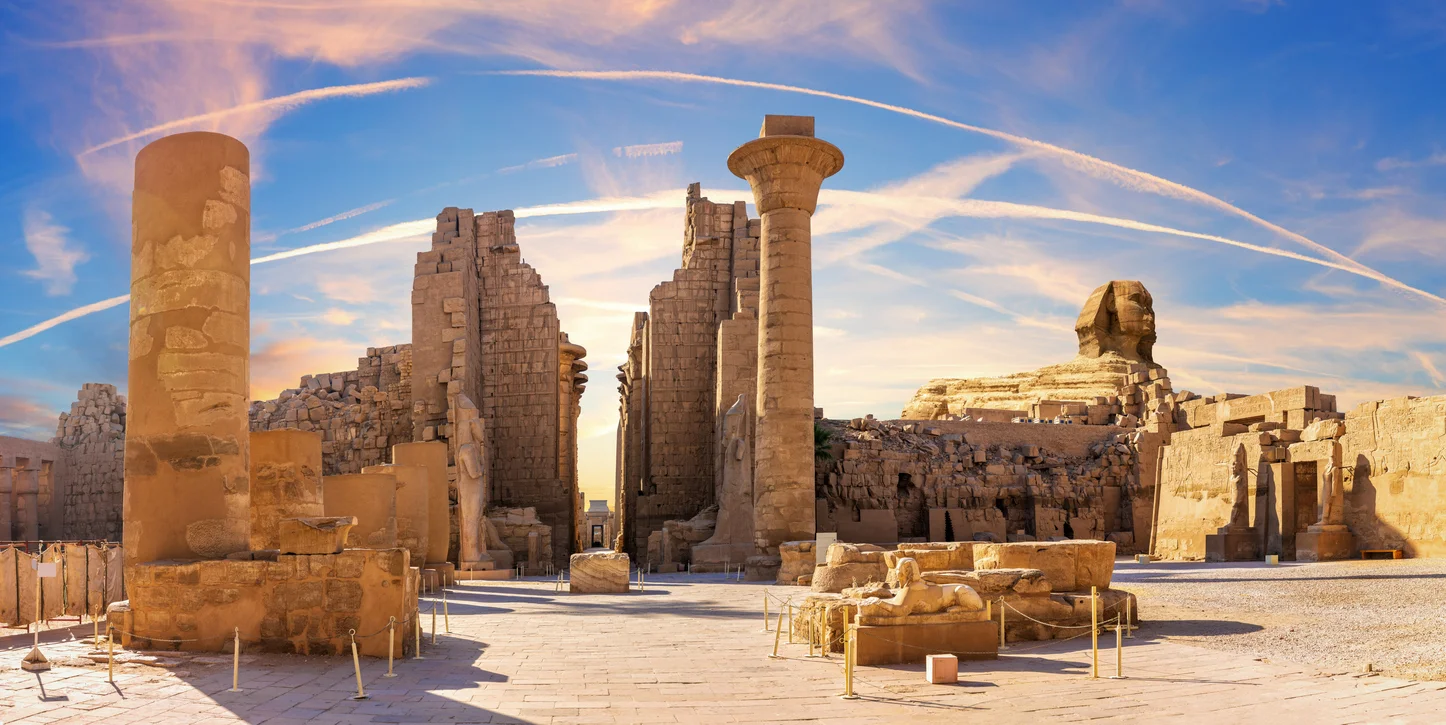
Karnak Temple
History, Monuments & Hidden Secrets — The Sacred Heart of Ancient Thebes and Egypt’s Greatest Religious Complex
What is Karnak Temple?
Karnak Temple Complex is not a single temple, but a vast, sprawling city of gods — the largest religious building ever constructed. Located on the east bank of the Nile in Luxor (ancient Thebes), it was the most important place of worship in Egypt for over 2,000 years.
Dedicated primarily to the Theban Triad — Amun-Ra (king of the gods), his consort Mut, and their son Khonsu — Karnak was a living, evolving monument. Successive pharaohs from the Middle Kingdom to the Ptolemaic period added pylons, obelisks, halls, and chapels, each trying to outdo their predecessors.
Its sheer scale is staggering: covering over 200 acres, it’s large enough to fit 10 cathedrals inside. The complex includes temples, chapels, massive pylons, sacred lakes, and avenues of sphinxes.
Who built Karnak, and how did it evolve?
Construction began in the Middle Kingdom (c. 2055–1650 BCE), but Karnak truly flourished during the New Kingdom (c. 1550–1070 BCE), when Thebes was Egypt’s capital.
Key Builders:
- Senusret I (12th Dynasty): Built the earliest known structure — a small limestone chapel, parts of which still stand.
- Hatshepsut & Thutmose III (18th Dynasty): Erected towering obelisks and expanded the central temple. Hatshepsut’s obelisk (still standing) is the tallest ancient obelisk in the world.
- Amenhotep III (18th Dynasty): Added the Third Pylon and began work on the massive Third Court.
- Seti I & Ramses II (19th Dynasty): Constructed the awe-inspiring Hypostyle Hall — a forest of 134 giant columns, the largest of which reach 24 meters (79 ft) high.
- Ramses III (20th Dynasty): Built a small temple within the complex dedicated to himself.
The complex continued to grow for centuries, with additions by Nubian, Saite, and even Ptolemaic rulers. It was a continuous work-in-progress for nearly 1,500 years.
Why is the Hypostyle Hall so famous?
The Great Hypostyle Hall is the crown jewel of Karnak and one of the most breathtaking architectural achievements of the ancient world.
Key Facts:
- Size: Covers 5,000 m² (54,000 sq ft) — larger than Notre Dame Cathedral.
- Columns: 134 massive sandstone columns arranged in 16 rows. The 12 central columns are 24m (79 ft) tall and 3.5m (11 ft) in diameter — designed to resemble blooming papyrus plants.
- Decoration: Every surface is covered in intricate hieroglyphs and painted reliefs depicting pharaohs making offerings to the gods, recording military victories, and detailing religious rituals.
- Builders: Primarily constructed by Seti I and completed by his son, Ramses II.
Walking through the hall feels like entering a stone forest, where light filters down from clerestory windows, casting dramatic shadows and highlighting the vibrant, ancient colors that still survive.
What was the purpose of the Sacred Lake?
The large, rectangular Sacred Lake (120m x 77m) was not for decoration — it was central to the temple’s daily rituals.
Functions:
- Purification: Priests bathed in its waters before performing sacred rites to cleanse themselves spiritually and physically.
- Ritual Use: Water from the lake was used in ceremonies, including the daily “Opening of the Mouth” ritual to animate statues of the gods.
- Symbolism: Represented the primordial waters of creation (Nun) from which life emerged.
- Practical: Served as a reservoir for the temple and was home to ducks, geese, and the sacred Opet Festival barque (a ceremonial boat).
Carved from a single block of stone on the lake’s edge is a giant scarab beetle, symbolizing rebirth. It’s said that walking around it 7 times while making a wish will grant it — a tradition still followed by visitors today.
What do the obelisks and pylons represent?
Obelisks: These towering, needle-like monuments were erected in pairs at temple entrances. Carved from a single piece of red granite, they were capped with electrum (gold-silver alloy) to catch the first and last rays of the sun, symbolizing the connection between earth and the sun god Ra.
- Hatshepsut’s Obelisk: At 29.5m (97 ft) tall, it’s the tallest ancient obelisk still standing in its original position.
- Missing Obelisks: Many were taken by foreign powers. One of Hatshepsut’s pair now stands in Istanbul, and another from Karnak is in the Place de la Concorde in Paris.
Pylons: These massive gateway walls (there are 10 at Karnak) represented the horizon (akhet), where the sun rose and set. They were decorated with scenes of the pharaoh smiting enemies, symbolizing the triumph of order (ma’at) over chaos.
Each pylon marked the entrance to a new, more sacred courtyard, leading the visitor deeper into the heart of the divine.
Are there hidden chambers or astronomical secrets?
Karnak is full of mysteries, both discovered and yet to be uncovered.
Hidden Chambers: In 2006, French archaeologists using ground-penetrating radar discovered a network of previously unknown chambers and corridors beneath the temple floor, suggesting there’s still much to be found.
Astronomical Alignments:
- The main axis of the temple is aligned with the rising sun during the winter solstice. On this day, sunlight penetrates deep into the sanctuary, illuminating statues of the gods — a powerful symbol of rebirth.
- The temple of Amun-Ra is aligned so that on certain days, the setting sun casts a beam of light down the central aisle of the Hypostyle Hall.
The Opet Festival: Once a year, a grand procession carried the statues of Amun, Mut, and Khonsu from Karnak to Luxor Temple (2.7km away) along the Avenue of Sphinxes. This festival symbolized the renewal of the pharaoh’s divine power and the fertility of the land.
| Feature | Detail |
|---|---|
| Location | East Bank of the Nile, Luxor, Egypt |
| Primary Deity | Amun-Ra |
| Construction Period | c. 2000 BCE – 30 BCE (Over 2,000 years) |
| Size | Over 200 acres (largest religious complex in the world) |
| Most Famous Structure | The Great Hypostyle Hall |
| Tallest Obelisk | Hatshepsut’s Obelisk (29.5m / 97 ft) |
| Sacred Lake | 120m x 77m — used for priestly purification |
| UNESCO World Heritage Site | Since 1979 (as part of Ancient Thebes) |


