


Abu Simbel: Where the Sun Meets Civilization and Immortality
In the heart of the Nubian desert, on the shimmering shores of Lake Nasser, the Abu Simbel Temple stands defiantly an eternal challenge to time and a royal proclamation carved in stone. It is not merely a tourist destination… but rather an architectural marvel, an astronomical phenomenon, and a Pharaonic legend that has pulsed with life for over 3,200 years.
From the colossal statues of Ramses II that radiate divine authority, to the awe-inspiring solar alignment phenomenon that continues to baffle scientists and captivate travelers, Abu Simbel encapsulates a rich tapestry of political power, religious devotion, and artistic mastery. Every wall tells a story stories of an ancient civilization that refused to be forgotten.
Whether you’re a lover of Ancient Egyptian temples, or a seeker of unforgettable experiences in southern Egypt, a visit to Abu Simbel is more than a journey it’s a time-traveling voyage into the undying glory of a civilization etched into every stone and illuminated by every sunbeam.
What Is Abu Simbel Temple, and Why Was It Built?
The Abu Simbel Temple is far more than a place of worship it is a political manifesto carved into the heart of a mountain, a royal display of power as vast as the desert itself. Situated on the western bank of Lake Nasser, deep in southern Egypt, about 280 kilometers from Aswan, this monumental temple was commissioned by Ramses II, one of the greatest pharaohs of the New Kingdom of Ancient Egypt, during the 13th century BCE, specifically in the fifth year of his reign around 1264 BCE.
But the real question remains: why was this temple built on such a colossal scale, and in such a remote location?

The answer lies in its multilayered purpose:
Politically, Ramses II aimed to assert control over Nubia and secure Egypt’s southern frontier. By erecting this temple at the edge of his kingdom, he sent an unmistakable message a monumental warning to anyone who dared to challenge his sovereignty.

Religiously, the temple was dedicated to a fusion of powerful deities: Amun-Ra, Ra-Horakhty, and Ptah, along with the deified image of Ramses himself. This blending of divine worship with royal glorification reflects Ramses’ calculated effort to merge religious authority with kingship, strengthening his divine right to rule.
Symbolically, Abu Simbel stood as a lasting tribute to Ramses’ military prowess, particularly his famed (and controversial) Battle of Kadesh. Carvings on the temple walls depict this campaign as a glorious triumph, even though the historical outcome was far from decisive.
In essence, the Abu Simbel Temples were not built for conventional worship alone. They were diplomatic statements, religious icons, and military monuments sculpted into timeless stone to echo across the ages.
Why Was Abu Simbel Built? A Strategic and Symbolic Masterplan
The Abu Simbel Temple, constructed by King Ramses II in the 13th century BCE, was far more than a conventional place of worship it was a multi-layered ideological project. From its remote location and architectural layout to its astronomical alignment and political messaging, every element reveals the mind of a ruler who sought not only to reign, but to immortalize himself as a living god within the very fabric of time and space.

1. Deification of the King: The God in Stone
One of the temple’s primary purposes was to establish the cult of Ramses II as a deified monarch. His towering statues, nearly 20 meters high, stand shoulder to shoulder with those of Ra-Horakhty, Amun-Ra, and Ptah, symbolizing that Ramses was not merely a king but a peer to the gods. The facade acts as a metaphysical manifesto, elevating royal authority from the political to the divine.
2. A Deterrent at the Southern Border
Strategically located at Egypt’s far southern border, in Lower Nubia, the temple served as a geo-political landmark:
“I am here, even at the edge of the world do not trespass.”
Abu Simbel was a dual-purpose structure: a symbolic fortress to dazzle Egyptian subjects and to intimidate foreign powers especially the Nubian kingdoms with a monumental declaration of territorial dominance.
3. A Propaganda Platform for Military Glory
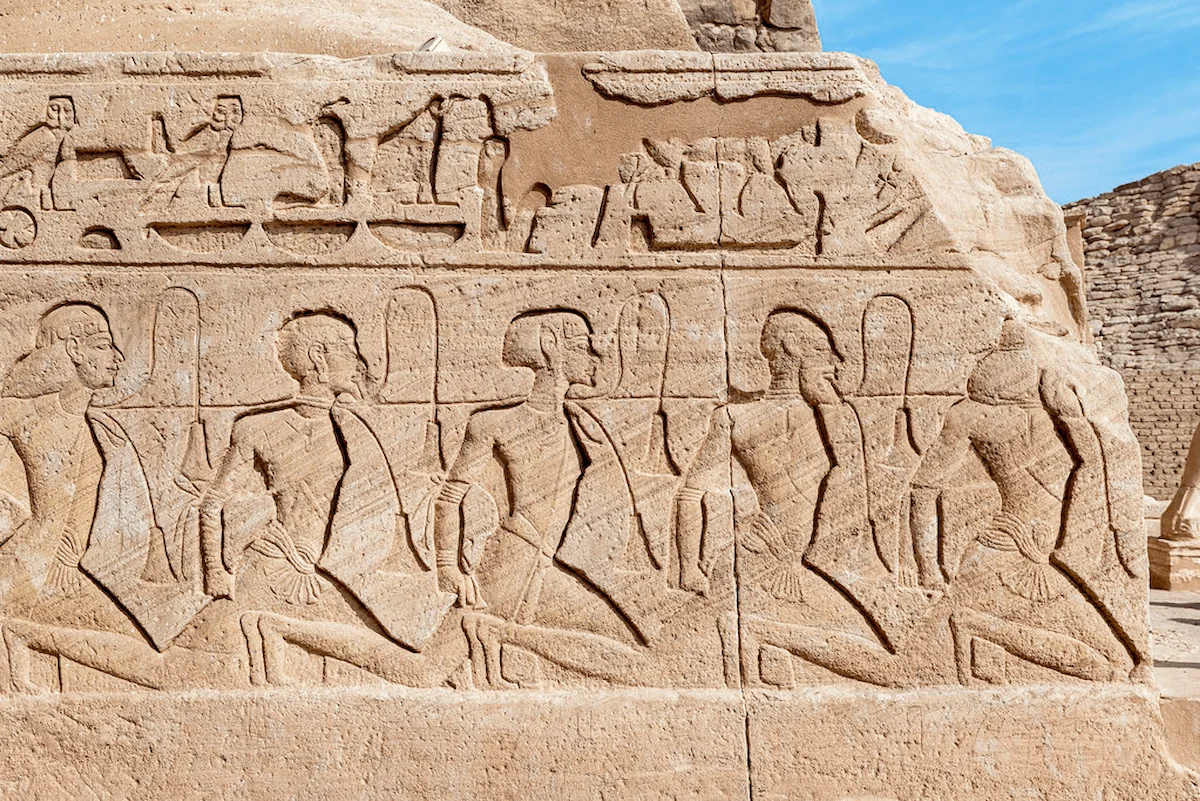
Inside, the temple’s carvings glorify the Battle of Kadesh, portraying Ramses as a heroic conqueror, even though historical records suggest a stalemate. This use of architectural propaganda helped reshape public memory and project Ramses II’s military prowess to both local and foreign audiences.
4. A Unified Religious Shrine
Rather than being devoted to a single deity, Abu Simbel blends the spiritual centers of Thebes (Amun), Memphis (Ptah), and Heliopolis (Ra-Horakhty) along with Ramses himself. This wasn’t just theology; it was politics. The temple served as a sacred fusion of Egypt’s main religious powers, all united under the authority of the king.

5. A Planned Astronomical Miracle
The famous solar alignment where sunlight penetrates the inner sanctuary twice a year (on October 22 and February 22) was no coincidence. It was an intentional display of astronomical precision, casting Ramses II as the cosmic axis of the universe. The sun itself appears to honor his divine rule, reinforcing his status as more than mortal.
6. A Soft Power Tool for Foreign Diplomats
Abu Simbel also functioned as a tool of ancient Egyptian soft power. Foreign delegations, emissaries, and dignitaries arriving in southern Egypt would be confronted with an overwhelming visual message:
“Witness the greatness of my civilization, my science, my destiny.”
In this sense, the temple became a diplomatic statement carved in stone.
7. Immortality Beyond Death
Finally, the temple was designed with an eternal perspective. Like the Great Pyramid of Khufu, which immortalized a king through monumental architecture, Ramses II sought to eternalize his legacy in a temple where the sun would never set. It was not just a temple of worship it was a cosmic tomb of remembrance.
The Inner Architecture of the Great Temple at Abu Simbel: A Masterpiece Carved into the Mountain
When you step into the Great Temple of Abu Simbel, you’re not simply entering an ancient structure you’re crossing the threshold into the mind and soul of Pharaoh Ramses II. This temple is not just a feat of rock-cut engineering; its creators etched an eternal message in stone, revealing the grandeur of a king and the genius of Ancient Egyptian architecture.
The Entrance and Facade: Awe Before the First Step

The massive façade greets you with four colossal seated statues of Ramses II, each nearly 20 meters high, gazing steadfastly toward the eastern horizon, as if standing guard over the eternal Nile. These statues are not mere monuments to power they portray different stages of Ramses’ life, adding a psychological depth to this monumental shrine.
First Hypostyle Hall: Embodying Divine Power

As they step inside, visitors are greeted by a majestic hypostyle hall lined with eight massive Osiride pillars, each carved in the likeness of Ramses as the god Osiris, symbolizing rebirth and immortality. This iconography is not coincidental rather, it delivers a clear and deliberate statement of divine kingship, seamlessly blending pharaonic power with eternal godhood.
Second Hall: From Political Theater to Sacred Ritual

The next chamber is smaller and more intimate, adorned with religious scenes and carvings of offerings to deities such as Amun-Ra, Ra-Horakhty, and Ptah. Here, the temple transitions from a space glorifying the king to a sacred stage where human devotion meets divine presence.
Sanctuary: The Beating Heart of Belief
Finally, the journey culminates at the sanctuary, the holiest space within the temple. It houses four seated statues Amun, deified Ramses, Ra-Horakhty, and Ptah. The room was designed with astonishing astronomical precision: twice a year, on February 21 and October 21, the rising sun pierces through the temple’s axis, illuminating the faces of the first three statues. The fourth, Ptah, god of the underworld, remains in perpetual shadow a brilliant fusion of symbolism, cosmic alignment, and architectural mastery.

This design is no coincidence it is a declaration that Ramses II was not merely a ruler of Egypt, but a cosmic sovereign, whose divine essence could command even the sun.
The Small Temple at Abu Simbel – Nefertari’s Shrine: Queen of Hearts and Goddess of Love

If the Great Temple of Abu Simbel stands as a monument to royal power and divine rule, then the Small Temple, which Ramses II dedicated to Queen Nefertari, becomes a love poem carved in stone. Ramses II commissioned this temple to honor his beloved wife, making it the only one in Ancient Egyptian history where a king ordered a temple for his queen beside his own and nearly equal in scale.
This was not just an architectural gesture; it was a royal proclamation:
“This is no ordinary queen this is a woman worthy of worship.”
Purpose Behind the Small Temple
Pharaoh Ramses II consecrated the temple to the goddess Hathor, the divine embodiment of love, music, beauty, and motherhood. Artists portrayed Queen Nefertari as Hathor’s earthly form. The temple fulfilled a dual purpose.
- To venerate Hathor, honoring the divine feminine in the Egyptian cosmic order.
- To immortalize Nefertari’s unique status, not only as Ramses’ wife but as a national figure of sacred importance.

The Majestic Facade – The Radiance of a Royal Woman
Carved entirely into the mountainside, the temple’s façade features six colossal statues, each standing about 10 meters tall. What makes it extraordinary is this:
- Four statues represent Ramses II,
- Two represent Nefertari,
Yet all six statues are of equal height a rare and powerful statement in royal iconography.
In most temples, queens appear far smaller than their kings. Here, equality in size symbolizes equality in reverence or at the very least, a closeness in honor and affection that defies tradition.
Interior Architecture – A Dialogue Between Woman and Deity
Inside the temple, visitors encounter:
- A main hall supported by columns shaped like Hathor’s head a symbol of femininity and fertility.
- Wall carvings depicting Ramses and Nefertari making offerings to various gods.
- Scenes portraying Nefertari as a high priestess, emphasizing her spiritual authority alongside her political and personal roles.

The colors remain remarkably vivid especially the rich blues, reds, and golds evoking a sense of divine elegance and eternal sanctity.
The Temple’s Message – Love and Sovereignty Entwined
This temple is not just a beautiful sanctuary. It is an eternal declaration of love, devotion, and shared sovereignty. Ramses II didn’t merely crown Nefertari as queen of his court he carved her into the landscape of eternity, beside him, in a temple that time cannot erase and the sun cannot overshadow.
In the southern heart of Egypt, she stands not just as a queen, but as a goddess of everlasting love.
Astronomical Wonders of Abu Simbel: Timeless Genius in Stone and Sunlight
Among the many marvels of the Great Temple of Ramses II at Abu Simbel, one phenomenon continues to captivate scientists, scholars, and visitors alike a celestial event so precise it defies coincidence: the solar alignment that occurs twice a year, illuminating the inner sanctuary with a golden shaft of dawn.
✦ A Cosmic Event Engineered by Human Hands
On February 22 and October 22 widely believed to mark Ramses II’s coronation and birthday the sun rises in perfect alignment with the temple’s axis. At that precise moment, its rays pierce a 60-meter-long rock-cut corridor, gradually journeying deep into the mountain to reach the Holy of Holies, where four statues sit in divine silence. This rare solar event is a testament to the astronomical precision of Ancient Egyptian architecture.
As sunlight floods the chamber, it lights up:
- 🗿 Ramses II deified as a living god
- 🌞 Ra-Horakhty the solar deity of the horizon
- 🔱 Amun-Ra the creator god, lord of Karnak
Only one figure remains in shadow: Ptah, god of the underworld his darkness symbolizing death and eternal mystery, an intentional and spiritually loaded detail of ancient Egyptian theology.
✦ Decoding the Light: Divine Kingship or Cosmic Calendar?
This spectacle is no accident it is the outcome of meticulous planning, a testament to Pharaonic mastery in astronomy, architecture, and theology.

- Many scholars see it as an affirmation of divine kingship. With Ramses positioned as part of a sacred triad receiving the sun’s blessing.
- Others interpret the alignment as a cosmic calendar, tied to agricultural cycles. With October marking sowing season and February the peak of harvest. Further embedding the king within the rhythms of life, death, and renewal.
✦ After the Relocation: Precision Preserved
When the temples were relocated in the 1960s to save them from the rising waters of Lake Nasser. Preserving this solar miracle became one of the most difficult engineering challenges. The result? A success that borders on the miraculous. The alignment now occurs one day earlier on February 21 and October 21. A negligible shift considering the monument was dismantled, moved, and reassembled stone by stone.
This slight deviation does not diminish the brilliance of the original design, nor the modern feat of preserving it. On the contrary, it reinforces a timeless truth:
The pharaohs didn’t just build for eternity they calculated it.
Abu Simbel remains a living dialogue between ancient genius and modern achievement. Its light continuing to tell a story that began more than 3,000 years ago. One written not in ink, but in sunlight, stone, and stars.
Abu Simbel Temples: When the Sands Whisper Secrets and Civilization Triumphs
For centuries, the Nubian sands buried the temples of Abu Simbel, concealing their grandeur beneath layers of silence. Only the colossal heads of stone gods remained visible. Like ghosts of a forgotten empire, half-buried and solemn, waiting for resurrection.

In 1813, Swiss explorer Johann Ludwig Burckhardt caught a glimpse of this lost splendor. He spotted part of an immense statue protruding from the dunes silent, stoic, and majestic. Although he was unable to enter. His notes would ignite a race toward one of the most significant archaeological rediscoveries of the modern era.

In 1817, famed Italian adventurer Giovanni Battista Belzoni. Driven by curiosity and bold determination, took up the task of unearthing the temple. After laborious excavation, he finally stepped into the Great Temple of Ramses II. The first human to do so in over three millennia.
What he found was not merely a ruin, but a resurrected civilization: towering statues, rock-hewn halls. And sacred inscriptions narrating tales of divine kingship, cosmic order, and military glory.
This was more than archaeology it was a revival of ancient Egyptian genius, frozen in stone and starlight. Abu Simbel spoke again: “I am here, and I shall remain.”
But the story did not end with its discovery…
A New Threat: Drowning in Progress
By the mid-20th century, a new challenge emerged one far more menacing than desert sands. The Aswan High Dam project threatened to submerge the Abu Simbel temples forever beneath the rising waters of Lake Nasser. Egypt faced an impossible choice: surrender its ancient heritage to modern development, or achieve a miracle of preservation.
In response, the world united. Under the auspices of UNESCO, one of the greatest feats in the history of cultural preservation began.Between 1964 and 1968, a team of engineers and archaeologists carefully cut the temples into over 1,000 stone blocks, some weighing more than 30 tons. They meticulously labeled each block, moved it 200 meters back and 65 meters higher uphill, and reassembled the entire structure with remarkable engineering precision.
But this was no mere relocation. Engineers went further they realigned the temples to preserve the solar alignment. Ensuring that the sun would continue to illuminate Ramses’ divine face, just as it had for over 3,200 years. A miracle repeated by human hands, once again.
A Global Symbol of Cultural Determination

Today, the rescue of Abu Simbel stands as a beacon of international cooperation. A triumph of human will over time and tide. It proves that the temples are not only monuments to the power of ancient Egypt. But also to the modern Egyptian spirit unyielding, proud, and committed to protecting its identity.
Abu Simbel is no longer just a testimony to the past.
It is a declaration:
Civilization can rise again if it chooses to remember.
Abu Simbel’s Rescue: The Epic of the 20th Century

In the 1960s, as Egypt stood at the threshold of a grand national dream, the construction of the Aswan High Dam brought with it a perilous threat: the rising waters of Lake Nasser. These waters, though vital to the country’s future, were set to engulf an irreplaceable jewel of ancient heritage the Temples of Abu Simbel. What followed was no mere effort to preserve stone. Rather, it was a battle to save identity, memory, and the soul of a civilization.
The Danger Rises: A Global Call to Arms

With the announcement of the High Dam project, alarm bells rang across the archaeological world. The temples originally carved into a cliff on the west bank of the Nile would soon be submerged. For the first time in its history, UNESCO issued a global humanitarian appeal to protect mankind’s shared heritage. Thus began the greatest archaeological rescue operation in modern history.
The Rescue Plan: Disassemble, Relocate, Rebirth
There was no precedent for the challenge ahead. After years of intensive planning, a bold and seemingly impossible solution was proposed: cut the temples into pieces. Move them, and reconstruct them on higher ground 200 meters away and 65 meters above their original position.

- Timeline: 1964–1968
- Lead Entity: UNESCO, with contributions from over 50 nations
- Techniques: Laser surveying, architectural modeling, precision sawing, advanced transport systems. The modern world’s finest tools were placed in the service of ancient Egypt.
Engineers and preservation teams carefully labeled, transported, and reassembled more than 1,000 stone blocks some weighing over 30 tons with astonishing precision. They also worked meticulously to preserve the original astronomical alignment, especially the temple’s sacred solar orientation.
Preserving the Solar Miracle: The Ultimate Challenge
Perhaps the crowning achievement of the relocation was not just physical survival. But the faithful replication of the solar alignment phenomenon. The biannual solar illumination of Ramses II’s face inside the sanctuary (on February 22 and October 22).

This challenge required astro-engineering genius. The new site was aligned with millimetric accuracy, and to this day. The Sun Temple phenomenon still occurs now just one day earlier a nearly flawless preservation of cosmic legacy.
Why This Rescue Mattered
- A global symbol of cultural cooperation and human achievement
- The first successful international heritage rescue mission
- Recognized as a UNESCO World Heritage Site in 1979, part of the “Nubian Monuments from Abu Simbel to Philae”
The rescue of Abu Simbel was more than a feat of engineering it was an act of cultural defiance. A refusal to let history drown. In this modern epic, the pharaohs found allies in the nations of the world. And once again, their legacy was etched into eternity.
The temples still stand, not just as a memory of ancient glory, but as proof that when the world unites for heritage, civilization wins.

Abu Simbel is no longer merely a monumental relic of a powerful pharaoh. It has become a pillar of cultural pride and a cornerstone of Egypt’s modern identity. Both the Great and Small Temples attract tens of thousands of visitors each year. Particularly during the solar alignment events on February 22 and October 22. These biannual spectacles, when the sun’s rays penetrate the temple’s inner sanctum to illuminate the face of Ramses II. Are not just visual marvels they are cultural rituals, blending science, spirituality, and ancient architectural genius. On these days, the west bank of Lake Nasser transforms into a living festival.
Tourism: An Economic Engine and a Cultural Window
Abu Simbel is a major economic asset for Egypt’s tourism industry, but its impact runs deeper. The site serves as a gateway to Nubian culture, long marginalized but profoundly rooted in Egypt’s southern heritage. Following the displacement of Nubian communities during the construction of the Aswan High Dam. The temples remained behind as both witness and tribute to a civilization that has withstood time.

Today, many tours include interactive cultural experiences with local Nubian communities. Through these activities, visitors engage directly with the traditions, music, language, and stories of the people descendants of those who once shared the land with the pharaohs. As a result, the experience becomes a living dialogue between past and present, transforming heritage into something participatory rather than merely observational.
Education, Engineering, and Global Inspiration
Abu Simbel has also become an essential case study for students of archaeology, architecture, and heritage conservation. The temples are admired not only for their artistic and religious symbolism. But also for their astronomical alignment and engineering brilliance.

For modern preservationists and engineers, Abu Simbel stands as a global model of successful heritage rescue. Consequently, it proves that with vision and collaboration, people can safeguard even the most fragile legacies. As a result, scholars and professionals reference it in university courses, architectural conferences, and international heritage symposiums.
A Temple That Lives On

Abu Simbel is far more than stone and sand. It is a heartbeat of the ancient world still pulsing through modern Egypt. It connects a 3,000-year-old civilization to today’s cultural ambitions. -It reinforces that identity is not only inherited it is rediscovered, protected, and celebrated.
In every sunrise that touches the temple walls, in every child who learns its story, and in every traveler who stands in awe Abu Simbel lives, not as a memory, but as a message.
Frequently Asked Questions About Abu Simbel
Everything you need to know about Egypt’s most magnificent temple complex
What is Abu Simbel?
Abu Simbel stands as a magnificent temple complex consisting of two massive rock-cut temples carved directly into a mountainside. Furthermore, it represents one of Egypt’s most iconic archaeological sites and holds UNESCO World Heritage Site status, showcasing the pinnacle of ancient Egyptian architecture and artistic achievement.
In addition, the complex includes these remarkable structures:
- The Great Temple – First, Ramses II dedicated this to himself and the gods Amun-Ra, Ra-Horakhty, and Ptah
- The Small Temple – Second, Ramses II built this for Queen Nefertari and the goddess Hathor
Where is Abu Simbel located?
Abu Simbel sits in southern Egypt, near the border with Sudan. More specifically, you’ll find it:
- Approximately 280 kilometers south of Aswan
- On the western bank of Lake Nasser
- In the historical region of Lower Nubia
- About 40 kilometers north of the Sudan border
GPS Coordinates: 22°20’13″N 31°37’32″E
What country is Abu Simbel in?
Importantly, Abu Simbel lies within the Arab Republic of Egypt. Specifically, you’ll find it in the Aswan Governorate in the southernmost part of the country. Furthermore, it serves as a major tourist destination for the region.
When was Abu Simbel built?
Initially, Ramses II built Abu Simbel during the 13th century BCE. More specifically, here’s when:
- First, construction began in the 5th year of Ramses II’s reign
- Subsequently, this occurred around 1264 BCE
- Then, workers completed it approximately 20 years later
- As a result, the temples are over 3,200 years old today
Who built Abu Simbel?
First of all, Pharaoh Ramses II (also known as Ramses the Great) ordered the construction of Abu Simbel. Subsequently, he ruled Egypt from 1279 to 1213 BCE, and moreover, historians consider him one of the most powerful and celebrated pharaohs of the New Kingdom period.
During his 66-year reign, Ramses II commissioned over 100 monuments. However, Abu Simbel remains his most impressive achievement.
How long did it take to build Abu Simbel?
Overall, the construction of Abu Simbel took approximately 20 years to complete. Indeed, this massive undertaking required thousands of workers, skilled artisans, and engineers to carve the temples directly into the solid rock cliff face. Furthermore, the scale of the project demonstrates the power and resources of Ramses II’s reign.
How was Abu Simbel built?
Initially, ancient builders constructed Abu Simbel using rock-cut architecture. Specifically, they employed these techniques:
- First, carved directly into the sandstone cliff face
- Then, used copper and bronze tools, stone hammers, and wooden wedges
- Additionally, employed fire-setting techniques to crack the rock
- Moreover, created precise astronomical alignments through careful planning
- Finally, decorated the temples with intricate reliefs and hieroglyphics
What is Abu Simbel made of?
Undoubtedly, workers carved Abu Simbel entirely from Nubian sandstone. Moreover, they hewn the temples directly into the natural rock cliff, thus creating monolithic structures. Furthermore, the sandstone’s durability has helped preserve the temples’ intricate carvings and paintings for over three millennia. As a result, visitors today can still see remarkable details.
Why was Abu Simbel built?
First and foremost, Abu Simbel served multiple strategic purposes. Subsequently, Ramses II designed it to achieve several goals:
- Political Power: First, assert Egyptian dominance over Nubia and secure the southern frontier
- Divine Authority: Second, establish Ramses II as a living god alongside traditional deities
- Military Propaganda: Third, commemorate the Battle of Kadesh and project military might
- Religious Unity: Additionally, merge worship centers of Thebes, Memphis, and Heliopolis
- Diplomatic Statement: Furthermore, impress foreign delegations and demonstrate Egyptian superiority
- Eternal Legacy: Finally, ensure Ramses II’s immortality through monumental architecture
Why is Abu Simbel important?
Without a doubt, Abu Simbel’s importance extends across multiple dimensions. Therefore, scholars and tourists alike value it for numerous reasons. Moreover, its significance continues to grow:
Archaeological Significance: First of all, it represents one of the best-preserved examples of New Kingdom architecture
Astronomical Marvel: Additionally, the site demonstrates ancient Egyptian mastery of astronomy and engineering
Cultural Heritage: Furthermore, UNESCO recognizes it as a World Heritage Site representing human achievement
Historical Record: Also, the temples provide insights into ancient Egyptian politics, religion, and society
Modern Symbol: Finally, Abu Simbel represents successful international cooperation in heritage preservation
What is Abu Simbel famous for?
Notably, Abu Simbel has gained worldwide fame for several remarkable features. Most importantly, these include:
- Four Colossal Statues: First, 20-meter tall seated figures of Ramses II dominate the facade
- Solar Alignment Phenomenon: Additionally, twice yearly, sunlight illuminates the inner sanctuary
- The Great Rescue: Furthermore, engineers successfully relocated it to save it from Lake Nasser
- Queen Nefertari’s Temple: Also, Ramses II gave rare honor of equal-height statues for a queen
- Battle of Kadesh Reliefs: Finally, detailed military campaign carvings cover the walls
Who was Abu Simbel built for?
Ramses II built Abu Simbel for multiple recipients. Accordingly, the complex honors:
- The Great Temple: Ramses II dedicated this to himself (deified) and three major gods – Amun-Ra, Ra-Horakhty, and Ptah
- The Small Temple: He dedicated this to Queen Nefertari (his beloved wife) and the goddess Hathor
This dual dedication reflects both religious devotion and the pharaoh’s desire to immortalize himself and his queen.
What is the Abu Simbel Sun Festival?
Remarkably, the Abu Simbel Sun Festival celebrates the remarkable solar alignment phenomenon that occurs twice yearly. Specifically, visitors can witness this spectacular event on these dates:
- February 21 – Furthermore, scholars believe this marks Ramses II’s coronation
- October 21 – Additionally, experts think this marks his birthday
During these spectacular events, several amazing things happen:
- First, sunlight penetrates 60 meters into the temple
- Then, the rays illuminate three of four statues in the sanctuary
- Meanwhile, thousands of tourists gather before dawn
- Finally, local celebrations include traditional music and dance
Note: Originally, the phenomenon occurred on February 22 and October 22. However, it shifted one day after the temple’s relocation. Nevertheless, the spectacle remains equally impressive.
What causes the unique event to happen twice a year at Abu Simbel?
Precise astronomical engineering causes the solar alignment. In particular:
- Ancient engineers carefully calculated and oriented the temple’s axis
- They understood the sun’s annual path perfectly
- The temple faces east at a specific angle
- The corridor acts as a light channel
- Only Ptah (god of darkness) remains in shadow – intentionally
Consequently, this demonstrates the ancient Egyptians’ sophisticated understanding of astronomy and their ability to merge it with architecture and religious symbolism.
How tall are the statues at Abu Simbel?
The Great Temple features:
- Four colossal seated statues: 20 meters (65 feet) tall
- Eight Osiride pillars inside: 10 meters tall
The Small Temple displays:
- Six standing statues: 10 meters (33 feet) tall
- Unique feature: Queen Nefertari’s statues equal Ramses II’s in height
What is inside Abu Simbel?
The Great Temple contains:
- First Hypostyle Hall with 8 Osiride pillars
- Second smaller hall with offering scenes
- Side chambers for storage and rituals
- Inner sanctuary with four seated god statues
- Battle of Kadesh reliefs on the walls
- Colorful hieroglyphics and paintings
Meanwhile, the Small Temple houses:
- Hypostyle hall with Hathor-headed columns
- Vestibule with ritual scenes
- Sanctuary dedicated to Hathor
- Vibrant wall paintings still visible today
Who are the statues at Abu Simbel?
The Great Temple statues represent:
- Four colossal facade statues: All depict Ramses II at different ages
- Smaller figures at his feet: Family members including his mother, wife Nefertari, and children
- Interior Osiride pillars: Show Ramses II as the god Osiris
- Sanctuary statues: Feature Ptah, Amun-Ra, deified Ramses II, and Ra-Horakhty
Additionally, the Small Temple statues portray:
- Six facade statues: Four show Ramses II and two show Queen Nefertari
- Smaller figures: Display their children
- Interior: Artists depicted Nefertari as the goddess Hathor
Why was Abu Simbel moved?
Initially, engineers relocated Abu Simbel to save it from permanent submersion. Subsequently, several factors necessitated this move. Moreover, the situation became urgent:
- First, construction of the Aswan High Dam (1960-1970) began
- Second, creation of Lake Nasser, one of the world’s largest artificial lakes, followed
- Finally, rising water levels would have completely flooded the temples
Without intervention, Lake Nasser would have submerged these 3,200-year-old temples forever beneath 60+ meters of water. Therefore, immediate action became essential.
When was Abu Simbel moved?
To begin with, the relocation project followed this timeline. Subsequently, each phase proved crucial:
- 1960: First, UNESCO launches international appeal
- 1964: Then, relocation work begins
- 1968: Next, workers complete the project
- September 22, 1968: Finally, officials inaugurate the site at its new location
Ultimately, the entire operation took 4 years of intensive work by international teams. Moreover, it became a model for future preservation efforts.
How was Abu Simbel moved?
Impressively, the relocation process proved to be an engineering marvel. First and foremost, the team began with these crucial steps:
- Careful Documentation: Initially, photographers and surveyors recorded every detail
- Precision Cutting: Next, workers cut temples into 1,036 blocks (20-30 tons each)
- Meticulous Labeling: Then, teams numbered and catalogued each block
- Transportation: Subsequently, crews moved blocks to higher ground
- Reconstruction: After that, experts reassembled them like a massive 3D puzzle
- Artificial Hills: Additionally, engineers built concrete domes and covered them with rock
- Alignment Preservation: Finally, teams carefully maintained the solar phenomenon
Cost: Overall, $40 million USD (1960s value) – equivalent to over $300 million today
Countries Involved: Furthermore, over 50 nations contributed funds and expertise
How far was Abu Simbel moved?
Engineers relocated Abu Simbel:
- 200 meters (656 feet) back from the river
- 65 meters (213 feet) higher in elevation
As a result, this positioning ensured the temples would remain well above the highest water level of Lake Nasser while maintaining their eastern orientation for the solar alignment.
Where was Abu Simbel originally located?
Originally, ancient builders carved Abu Simbel into the natural sandstone cliffs on the west bank of the Nile River, at a lower elevation. Today, Lake Nasser completely submerges the original site. The temples faced east across the Nile, allowing the rising sun to penetrate the sanctuary – fortunately, engineers preserved this feature in the new location.
What were the proposed methods to save Abu Simbel that weren’t used?
Engineers proposed several methods before the final solution. However, they rejected each for specific reasons:
- First Method – Underwater viewing: Build a clear underwater dome around the temples. Engineers rejected this due to impracticality and maintenance issues.
- Second Method – Floating the temples: Cut the temples free as single blocks and float them to higher ground. They rejected this because of the rock’s fragility and enormous weight.
- Third Method – Concrete dam: Build a protective dam around the temples. Officials rejected this due to cost and long-term water seepage concerns.
Eventually, the chosen method of cutting into blocks and reassembling proved most feasible despite its complexity.
Who did the Egyptian government approach to save Abu Simbel?
The Egyptian government approached UNESCO (United Nations Educational, Scientific and Cultural Organization) in 1960. Subsequently, this led to:
- The first major international cultural rescue campaign
- Participation from over 50 countries
- Financial and technical support from around the world
- Establishment of the World Heritage Site program
Therefore, this cooperation became a model for future heritage preservation efforts globally.
How to get to Abu Simbel from Aswan?
Unquestionably, several options exist to reach Abu Simbel from Aswan. Specifically, you can choose from these alternatives. Furthermore, each has its advantages:
- By Air: First, take a 45-minute flight (most convenient option)
- By Road: Alternatively, join a 3-hour drive (280 km) – usually in convoy for security
- By Lake Cruise: Finally, some Nasser cruises include Abu Simbel
Tip: Most tours depart very early (3-4 AM) to arrive for sunrise and avoid the heat. Therefore, prepare for an early morning start.
How to get to Abu Simbel from Luxor?
From Luxor, you’ll need to go via Aswan. Therefore, plan your journey as follows:
- Luxor to Aswan: Take a train (3 hours), flight (1 hour), or road (3.5 hours)
- Aswan to Abu Simbel: Then follow the options mentioned above
Alternative: Some tour operators offer 2-day trips from Luxor including overnight in Aswan.
How to get to Abu Simbel from Cairo?
From Cairo, the most practical options include:
- Fly to Aswan: Take a 1.5-hour flight, then continue to Abu Simbel
- Direct flight: Book seasonal direct flights Cairo-Abu Simbel
- Overnight train to Aswan: Travel 12-13 hours, then continue
Moreover, most visitors include Abu Simbel as part of a broader Upper Egypt itinerary.
What time does Abu Simbel open?
Abu Simbel follows these opening hours:
- Summer (May-September): 5:00 AM – 6:00 PM
- Winter (October-April): 5:00 AM – 5:00 PM
Best Time to Visit: Arrive early morning (by 6 AM) for cooler temperatures and better photography lighting.
Sun Festival Days: The temple opens earlier (around 4 AM) to accommodate crowds.
What to see in Abu Simbel?
Essentially, you must see these highlights when visiting Abu Simbel. Moreover, each offers unique insights:
- First, four colossal statues of Ramses II at the Great Temple
- Second, Battle of Kadesh reliefs inside the Great Temple
- Third, inner sanctuary with four god statues
- Additionally, Queen Nefertari’s Temple facade with equal-height statues
- Furthermore, vibrant interior paintings and Hathor columns
- Finally, views of Lake Nasser from behind the temples
Recommended time: Therefore, allow 2-3 hours to properly explore both temples.
Where to stay in Abu Simbel?
Abu Simbel village offers these accommodation options:
- Seti Hotel Abu Simbel: Sits closest to the temples with lake views
- Nefertari Hotel: Provides budget-friendly options in the village
- Local Guesthouses: Offer basic but authentic Nubian experience
Alternative: Many visitors stay in Aswan and take day trips to Abu Simbel.
How many days should I spend in Abu Simbel?
The ideal duration depends on your interests. Consider these options:
- Half day: Provides minimum time for a rushed visit (most common for day trips from Aswan)
- 1 full day: Allows thorough exploration of both temples plus the visitor center
- 2 days: Suits photography enthusiasts – see the temples at sunrise and sunset
- 3 days: Only necessary if attending the Sun Festival or combining with Lake Nasser cruise
Tip: If staying overnight, you can enjoy the evening sound and light show and avoid the day-trip crowds.
Who discovered Abu Simbel?
Originally, two explorers rediscovered Abu Simbel in modern times. Specifically, here’s who found it:
- Johann Ludwig Burckhardt (1813) – First, this Swiss explorer spotted the temple tops
- Giovanni Battista Belzoni (1817) – Subsequently, this Italian explorer cleared the sand and entered the Great Temple
Previously, sand had buried the temples for centuries. As a result, only the tops of the colossal statues remained visible.
What does Abu Simbel mean?
Scholars debate the exact origin of the name “Abu Simbel,” though they believe it derives from Arabic:
- Possibly named after a local boy who guided early explorers to the site
- May come from ancient Egyptian “Ibshek” or “Abshek”
- The ancient Egyptians likely called it “The Temple of Ramesses, Beloved of Amun”
How to pronounce Abu Simbel?
Naturally, pronounce Abu Simbel as: AH-boo sim-BELL. More specifically:
- First, “Abu” – pronounce like “AH-boo”
- Second, “Simbel” – pronounce “sim-BELL” with emphasis on the second syllable
Was there a person named Abu Simbel?
According to some accounts, “Abu Simbel” may have been the name of a young local guide who led European explorers to the buried temples in the early 19th century. However, historians consider this more legend than confirmed fact. Certainly, Ramses II and Queen Nefertari built the temples themselves – no ancient Egyptian person named Abu Simbel existed.
Is there a connection between Abu Simbel and AC/DC’s “Who Made Who”?
Obviously, no direct connection exists between the ancient temples and the rock band AC/DC. However, the confusion may arise from search queries for “Abu Simbel who made who” – essentially, people searching for information about who built Abu Simbel. Meanwhile, AC/DC released their song “Who Made Who” in 1986 for the Stephen King film “Maximum Overdrive,” and therefore, it has no relation to Egyptian archaeology.
How does Abu Simbel demonstrate Ramses II’s significance in ancient Egypt?
Abu Simbel showcases Ramses II’s extraordinary status through multiple features:
- Unprecedented scale: Four 20-meter statues represent the largest ever carved in ancient Egypt
- Self-deification: Ramses portrayed himself as equal to the gods
- Architectural innovation: Solar alignment demonstrates advanced knowledge
- Political messaging: Strategic location asserted control over Nubia
- Longevity of reign: His 66-year rule allowed completion of massive projects
- Historical legacy: More monuments survive from his reign than any other pharaoh
Note: Don’t confuse Abu Simbel with the Ramesseum, which is Ramses II’s mortuary temple in Thebes (Luxor).
What monuments are located at Abu Simbel?
The Abu Simbel complex consists of these structures:
- The Great Temple of Ramses II – The larger temple with four colossal statues
- The Small Temple of Nefertari – Dedicated to the queen and goddess Hathor
- Ancient inscriptions and stelae – Including marriage stelae and Greek graffiti
- Chapel remains – Smaller rock-cut chapels in the vicinity
Together, these two main temples form one of the most impressive archaeological sites in Egypt.
What city is Abu Simbel in?
Abu Simbel sits in Abu Simbel village, a small settlement in the Aswan Governorate of southern Egypt. The village grew around the temples and serves primarily as a base for tourists visiting the archaeological site. Rather than a city, it functions as a small town near the Sudan border.
What happened to Abu Simbel? Why was it buried?
Interestingly, over the centuries, desert sand gradually buried Abu Simbel. More specifically, here’s what happened:
- First, natural sand accumulation occurred over 3,000+ years
- Subsequently, by the 6th century BCE, sand already reached the knees of the statues
- Eventually, sand covered it almost entirely, with only the tops of heads visible
- Finally, the site remained hidden for over 1,000 years until rediscovery in 1813
Interestingly, this sand burial actually helped preserve the temples’ colors and carvings from weathering. Therefore, what seemed like destruction became preservation.
What did Abu Simbel originally look like?
When workers first completed it around 1244 BCE, Abu Simbel would have appeared:
- Brilliantly painted – Artists vividly colored the statues and reliefs
- Highly polished – The stone surfaces gleamed smooth and reflective
- Fully visible – No sand obscured the facade or entrance
- Riverside location – Stood directly on the Nile bank (before Lake Nasser)
- Complete statuary – All four colossi remained intact (one later suffered earthquake damage)
Indeed, the temples would have been even more imposing, gleaming in the desert sun with their original paintwork.


